
JEE Advanced 2022 Paper 1, Physics Section 3 Q4: Thin Lens and Mirrors
List I contains four combinations of two lenses (1 and 2) whose focal lengths (in cm) are indicated in the figures. In all cases, the object is placed 20 cm from the first lens on the left, and the distance between the two lenses is 5 cm. List II contains the positions of the final images.
| List-I | List-II |
|---|---|
(I) 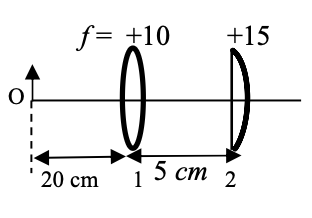 | (P) Final image is formed at 7.5 cm on the right side of lens 2. |
(II) 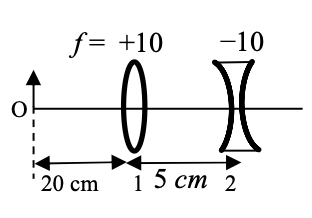 | (Q) Final image is formed at 60.0 cm on the right side of lens 2. |
(III) 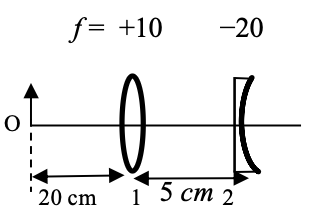 | (R) Final image is formed at 30.0 cm on the left side of lens 2. |
(IV) 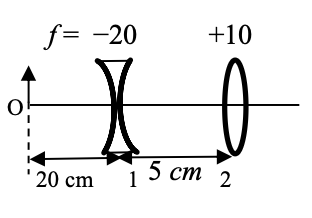 | (S) Final image is formed at 6.0 cm on the right side of lens 2. |
| (T) Final image is formed at 30.0 cm on the right side of lens 2. |
Which one of the following options is correct?
- A
(I) P; (II) R; (III) Q; (IV) T
- B
(I) Q; (II) P; (III) T; (IV) S
- C
(I) P; (II) T; (III) R; (IV) Q
- D
(I) T; (II) S; (III) Q; (IV) R
Use the thin lens formula with the sign convention (distances measured from each lens; negative for real object on the incoming side). Image from lens 1 becomes object for lens 2 after accounting for the 5 cm separation.
(I) Lens 1 (, ): cm to the right. So this image is cm to the right of lens 2, acting as a virtual object for lens 2 (). Lens 2 (): , so cm to the right. I P.
(II) Lens 1: cm; virtual object at for lens 2 (): , so cm (i.e., 30 cm to the left of lens 2). II R.
(III) Lens 1: cm; virtual object at for lens 2 (): , so cm to the right. III Q.
(IV) Lens 1 (, ): , so cm (10 cm to the left of lens 1). For lens 2, object distance cm. Lens 2 (): , so cm to the right. IV T.
The correct matching is option (A).
Concept behind this question
Thin Lens and MirrorsNotes, formulas and examples →More previous year questions on Thin Lens and Mirrors
Practice more Physics Section 3
Concept-wise practice with instant solutions on Fundamenthol.
Start practicing →