
JEE Advanced 2022 Paper 1, Chemistry Section 2 Q1: Molecular Orbital Theory
For diatomic molecules, the correct statement(s) about the molecular orbitals formed by the overlap of two 2p orbitals is(are)
- A
orbital has a total of two nodal planes.
- B
orbital has one node in the -plane containing the molecular axis.
- C
orbital has one node in the plane which is perpendicular to the molecular axis and goes through the center of the molecule.
- D
orbital has one node in the -plane containing the molecular axis.
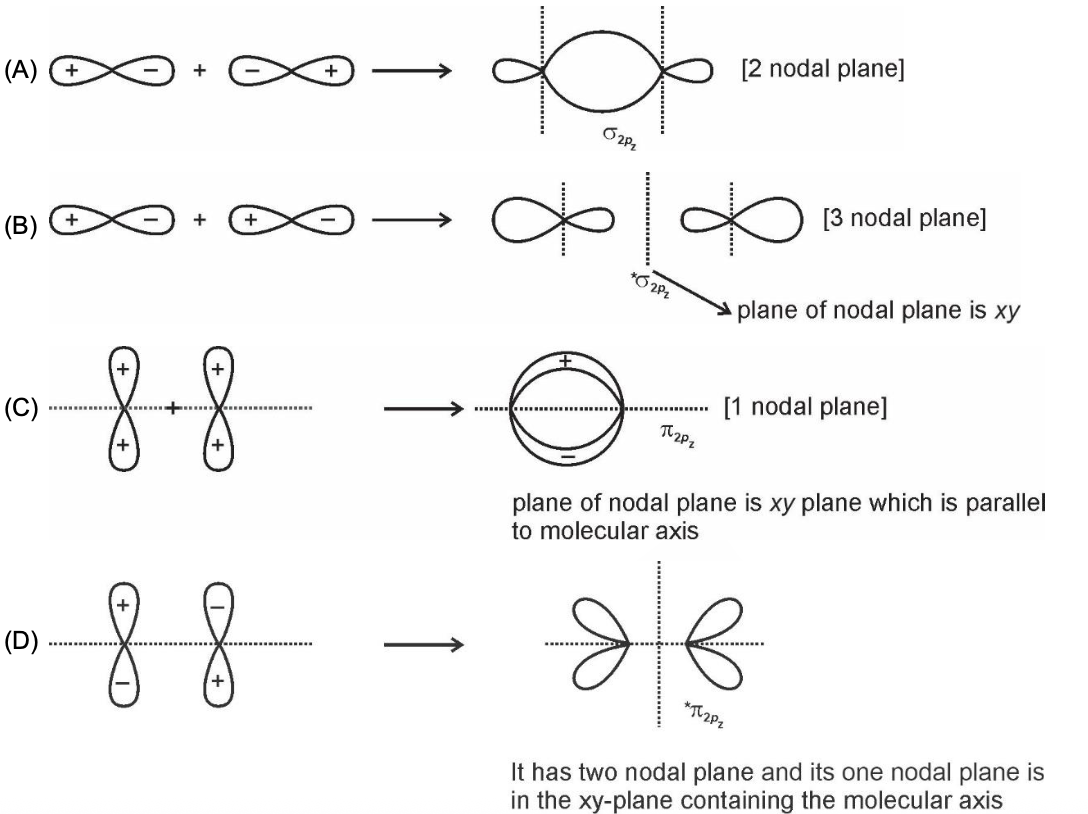
Take the molecular (internuclear) axis along .
(A) formed by end-on overlap of two 2p lobes has two nodal planes containing the axis (the - and -planes are not nodal here; rather the angular nodes from each 2p orbital contribute two planar nodes perpendicular to the orbital axes that the lobes lie along). Each constituent 2p has one nodal plane perpendicular to its lobe; in the bonding combination two nodal surfaces persist. Correct.
(B) has an additional node between the two nuclei (perpendicular to the bond axis), giving three nodal planes total. The single antibonding node is the -plane between the nuclei, not the -plane along the axis. Wrong.
(C) orbitals (formed from or ) have one nodal plane containing the molecular axis (the plane perpendicular to the lobes). They do not have a node perpendicular to the axis through the centre. Wrong.
(D) has two nodal planes: the one containing the molecular axis (inherited from ) and an additional perpendicular one between the nuclei. One of these planes contains the molecular axis. If the orbitals are formed from , the nodal plane containing the axis is the -plane; for overlap it is the -plane. The statement that has a nodal plane containing the molecular axis is correct. Correct.
Concept behind this question
Molecular Orbital TheoryNotes, formulas and examples →More previous year questions on Molecular Orbital Theory
Practice more Chemistry Section 2
Concept-wise practice with instant solutions on Fundamenthol.
Start practicing →