
JEE Advanced 2022 Paper 2, Physics Section 2 Q2: Energy, Power And Heating Effect
In Circuit-1 and Circuit-2 shown in the figures, , and .
and are the power dissipations in Circuit-1 and Circuit-2 when the switches and are in open conditions, respectively.
and are the power dissipations in Circuit-1 and Circuit-2 when the switches and are in closed conditions, respectively.
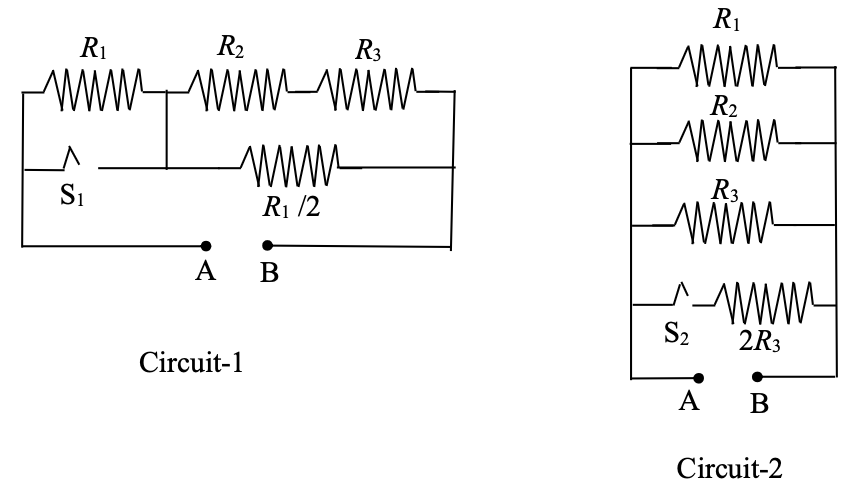
Which of the following statement(s) is(are) correct?
- A
When a voltage source of 6 V is connected across A and B in both circuits,
- B
When a constant current source of 2 Amp is connected across A and B in both circuits,
- C
When a voltage source 6 V is connected across A and B in Circuit-1,
- D
When a constant current source of 2 Amp is connected across A and B in both circuits,
When and are open
$(R_{eq})_1 = 1+\dfrac{5\times\dfrac{1}{2}} {5+\dfrac{1}{2}} = 1+\dfrac{5}{11} = \dfrac{16}{11}$
$P_1 = \dfrac{V^2}{R_{eq}} = \dfrac{(6)^2}{16/11} = \dfrac{36\times11}{16} = 24.75\ \text{W}$
$P_2 = \dfrac{V^2}{R_{eq}} = \dfrac{(6)^2}{6/11} = \dfrac{36\times11}{6} = 66\ \text{W}$
Option (A) is correct.
If a source is used in both the cases,
$P_1 = i^2(R_{eq})_1 = (2)^2\times\dfrac{16}{11} = \dfrac{64}{11} = 5.818\ \text{W}$
$P_2 = i^2(R_{eq})_2 = (2)^2\times\dfrac{6}{11} = \dfrac{24}{11} = 2.1818\ \text{W}$
Option (B) is correct.
For
$Q_1 = \dfrac{V^2}{R_{eq}} = \dfrac{(6)^2}{5/11} = \dfrac{36\times11}{5} = 79.2\ \text{W}$
Option (C) is correct.
For option (D)
$Q_1 = i^2R_{eq} = (2)^2\times\dfrac{5}{11} = \dfrac{20}{11} = 1.81\ \text{W}$
$Q_2 = i^2R_{eq} = (2)^2\times\dfrac{1}{2} = \dfrac{4}{2} = 2\ \text{W}$
Option (D) is incorrect.
Correct options: (A), (B), (C).
Concept behind this question
Energy, Power And Heating EffectNotes, formulas and examples →More previous year questions on Energy, Power And Heating Effect
Practice more Physics Section 2
Concept-wise practice with instant solutions on Fundamenthol.
Start practicing →