
JEE Advanced 2022 Paper 2, Physics Section 2 Q5: Young’s Double Slit Experiment
A double slit setup is shown in the figure. One of the slits is in medium 2 of refractive index . The other slit is at the interface of this medium with another medium 1 of refractive index . The line joining the slits is perpendicular to the interface and the distance between the slits is . The slit widths are much smaller than . A monochromatic parallel beam of light is incident on the slits from medium 1. A detector is placed in medium 2 at a large distance from the slits, and at an angle from the line joining them, so that equals the angle of refraction of the beam. Consider two approximately parallel rays from the slits received by the detector.
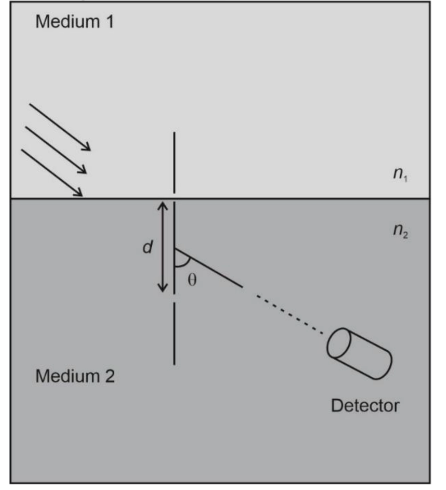
Which of the following statement(s) is(are) correct?
- A
The phase difference between the two rays is independent of d.
- B
The two rays interfere constructively at the detector.
- C
The phase difference between the two rays depends on n but is independent of n.
- D
The phase difference between the two rays vanishes only for certain values of d and the angle of incidence of the beam, with q being the corresponding angle of refraction.
Let be the angle of incidence in medium 1 and the angle of refraction in medium 2, with Snell's law .
The extra path in medium 1 before reaching the lower slit (which sits in medium 2 a distance below the interface slit) is (geometric path along the incident direction projected onto the slit line). After both slits radiate, the extra geometric path in medium 2 to the detector along the refracted direction is .
The optical path difference is therefore by Snell's law.
Hence the phase difference is identically zero, independent of , of , and of . The waves interfere constructively at the detector.
(A) Correct: phase difference does not depend on (it is always 0).
(B) Correct: constructive interference.
(C) Incorrect: the result is independent of both and .
(D) Incorrect: the phase difference vanishes for every and every incidence angle (as long as is the corresponding refraction angle).
Correct options: (A), (B).
Concept behind this question
Young’s Double Slit ExperimentNotes, formulas and examples →More previous year questions on Young’s Double Slit Experiment
Practice more Physics Section 2
Concept-wise practice with instant solutions on Fundamenthol.
Start practicing →