
JEE Advanced 2022 Paper 2, Chemistry Section 2 Q5: Properties and Important Reactions of Aldehydes & Ketones
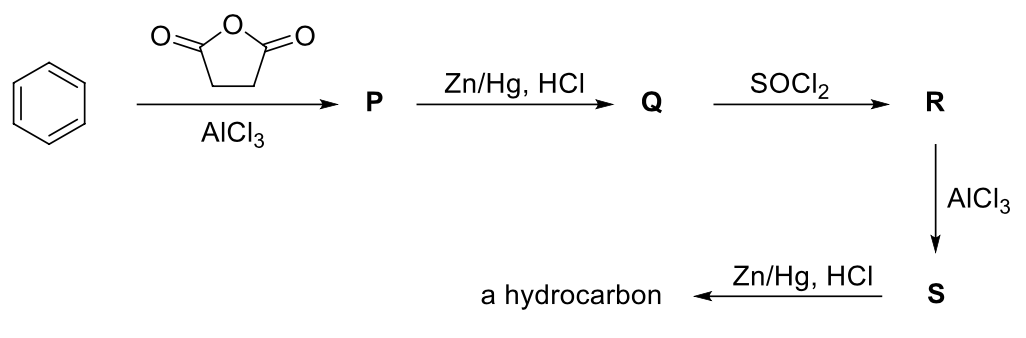
Considering the following reaction sequence, the correct statement(s) is(are)
- A
Compounds P and Q are carboxylic acids.
- B
Compound S decolorizes bromine water.
- C
Compounds P and S react with hydroxylamine to give the corresponding oximes.
- D
Compound R reacts with dialkylcadmium to give the corresponding tertiary alcohol.
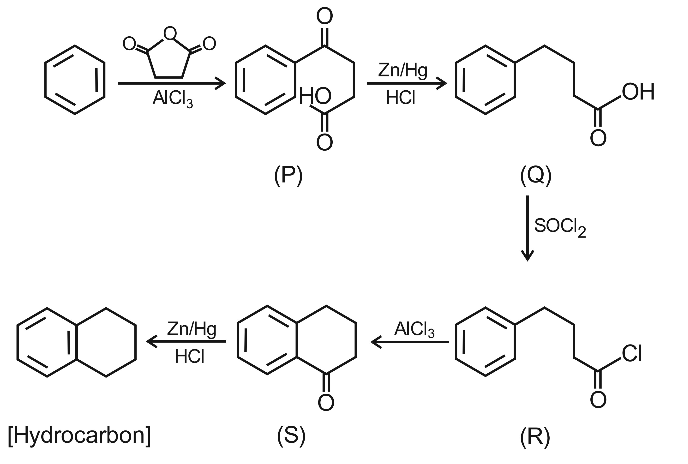
P is 4-oxo-4-phenylbutanoic acid (a keto-acid); Q is 4-phenylbutanoic acid; R is the corresponding acyl chloride; S is -tetralone (a cyclic aryl ketone).
(A) Both P and Q bear a COOH group; both are carboxylic acids. Correct.
(B) S is a saturated cyclic ketone fused to a benzene ring; it has no isolable C=C double bond outside the aromatic ring (aromatic rings do not decolorize Br water under normal conditions). Incorrect.
(C) Both P (contains a ketone CO) and S (cyclic ketone) react with NHOH at the carbonyl carbon to give oximes. Correct.
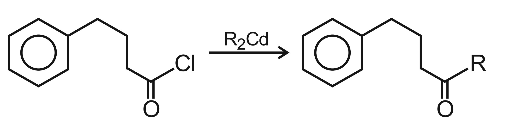
(D) Dialkylcadmium R'Cd is a mild nucleophile that converts acyl chlorides to ketones (it stops at the ketone stage and does not add twice). Hence R + R'Cd gives a ketone, not a tertiary alcohol. Incorrect.
(A), (C).
Concept behind this question
Properties and Important Reactions of Aldehydes & Ketones Notes, formulas and examples →More previous year questions on Properties and Important Reactions of Aldehydes & Ketones
Practice more Chemistry Section 2
Concept-wise practice with instant solutions on Fundamenthol.
Start practicing →