
JEE Advanced 2023 Paper 1, Physics Section 3 Q2: Thin Lens and Mirrors
An optical arrangement consists of two concave mirrors and , and a convex lens with a common principal axis, as shown in the figure. The focal length of is cm. The radii of curvature of and are cm and cm, respectively. The distance between and is cm. A point object is placed at the mid-point between and on the axis. When the distance between and is cm, one of the images coincides with . The value of is _______. (Assume that the light first refracts through L)
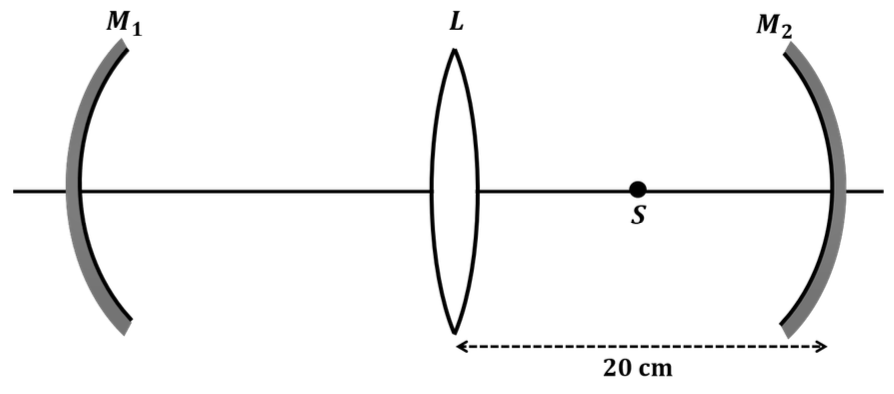
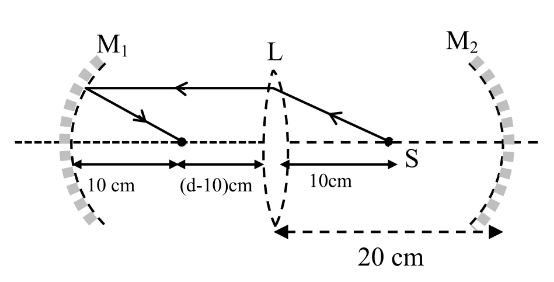
Setup. Focal lengths: cm (lens), cm, cm. The object sits cm to the left of and cm to the right of .
Path: light first refracts through , reflects off , refracts back through , reflects off , refracts through again, and arrives back at .
Step 1. Light from to the left strikes at distance cm. With , , the lens equation gives ; the emerging beam is parallel.
Step 2. A parallel beam reflecting off converges to its focus, i.e. at distance cm in front of .
Step 3. Let be the lens-to- distance. After reflection the image acts as object for at distance to the left of . Refraction through : , giving .
Step 4. The resulting image must serve as an object for whose final image, after another refraction through , coincides with . By tracing the return leg with producing an image at cm from , the consistency condition reduces to cm (image to the right of acting as virtual object for ).
Step 5. Substituting in step 3: . Hence , giving cm.
Comparing with : .
Concept behind this question
Thin Lens and MirrorsNotes, formulas and examples →More previous year questions on Thin Lens and Mirrors
Practice more Physics Section 3
Concept-wise practice with instant solutions on Fundamenthol.
Start practicing →