
JEE Advanced 2023 Paper 1, Physics Section 4 Q4: Motional EMF
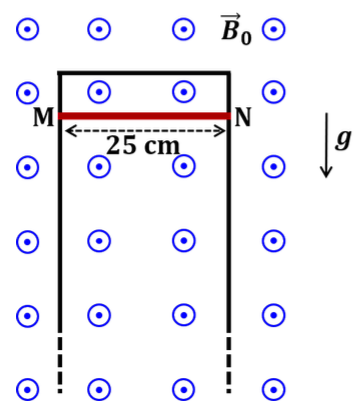
A thin conducting rod MN of mass gm, length cm and resistance is held on frictionless, long, perfectly conducting vertical rails as shown in the figure. There is a uniform magnetic field T directed perpendicular to the plane of the rod-rail arrangement. The rod is released from rest at time and it moves down along the rails. Assume air drag is negligible. Match each quantity in List-I with an appropriate value from List-II, and choose the correct option.
[Given: The acceleration due to gravity and ]
| List-I | List-II |
|---|---|
| (P) At s, the magnitude of the induced emf in Volt | (1) 0.07 |
| (Q) At s, the magnitude of the magnetic force in Newton | (2) 0.14 |
| (R) At s, the power dissipated as heat in Watt | (3) 1.20 |
| (S) The magnitude of terminal velocity of the rod in m s | (4) 0.12 |
| (5) 2.00 |
- A
P 5, Q 2, R 3, S 1
- B
P 3, Q 1, R 4, S 5
- C
P 4, Q 3, R 1, S 2
- D
P 3, Q 4, R 2, S 5
Equation of motion. The induced emf is , the current is , and the magnetic retarding force is . Newton's second law: .
Terminal velocity. Setting acceleration to zero: . (S) (5).
Time constant. Define , so .
Velocity at s. , so .
(P) Induced emf. V. Match (3).
(Q) Magnetic force. N. Match (4).
(R) Power dissipated. W W. Match (2).
Mapping: P 3, Q 4, R 2, S 5. Answer: (D).
Concept behind this question
Motional EMFNotes, formulas and examples →More previous year questions on Motional EMF
Practice more Physics Section 4
Concept-wise practice with instant solutions on Fundamenthol.
Start practicing →