
JEE Advanced 2023 Paper 1, Chemistry Section 2 Q4: Properties of Phenol
In the given reaction scheme, P is a phenyl alkyl ether, Q is an aromatic compound; R and S are the major products.
The correct statement about S is
- A
It primarily inhibits noradrenaline degrading enzymes.
- B
It inhibits the synthesis of prostaglandin.
- C
It is a narcotic drug.
- D
It is ortho-acetylbenzoic acid.
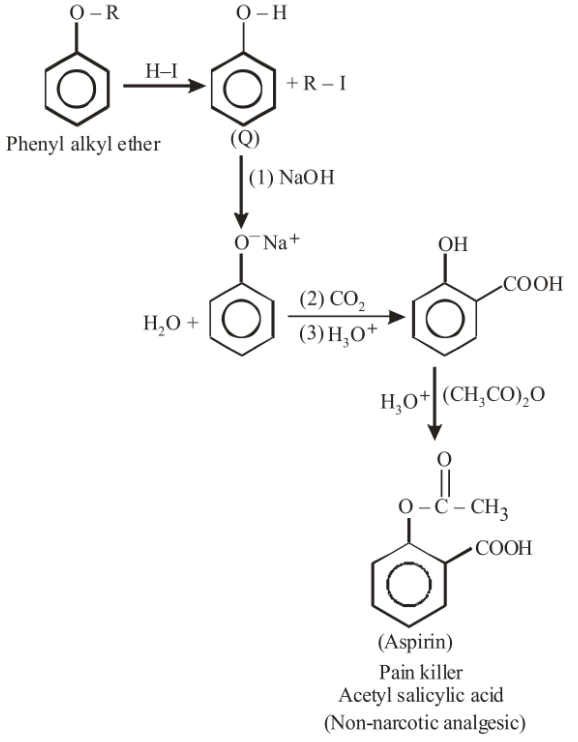
Identifying intermediates. The phenyl alkyl ether P on cleavage with HI gives phenol (Q) and an alkyl iodide. Phenol treated with NaOH gives sodium phenoxide which, on Kolbe-Schmitt carboxylation with CO followed by acidification, gives salicylic acid (2-hydroxybenzoic acid) as R.
Step R S. Acetylation of the phenolic OH of salicylic acid with acetic anhydride (and acid workup) gives acetylsalicylic acid, commonly known as aspirin.
Mode of action of aspirin. Aspirin is a non-narcotic analgesic that inhibits the cyclo-oxygenase enzymes responsible for the biosynthesis of prostaglandins. Hence option (B) correctly describes S. Aspirin is the ortho-acetoxy (not acetyl) benzoic acid, so option (D) is incorrect.
Answer: (B).
Concept behind this question
Properties of PhenolNotes, formulas and examples →More previous year questions on Properties of Phenol
Practice more Chemistry Section 2
Concept-wise practice with instant solutions on Fundamenthol.
Start practicing →