
JEE Advanced 2023 Paper 1, Mathematics Section 2 Q3: Introduction To Probability
Let . Three distinct points , and are randomly chosen from . Then the probability that , and form a triangle whose area is a positive integer, is
- A
- B
- C
- D
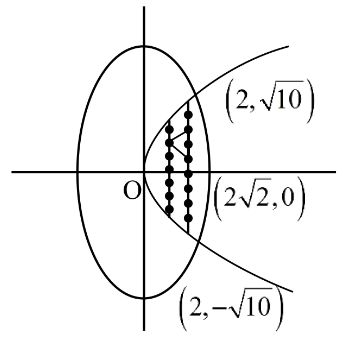
The two inequalities intersect on the boundary at , , and the ellipse meets the -axis at . Enumerating integer points satisfying both strict inequalities, the candidates fall on the vertical lines and :
: (five points).
: (seven points).
So and the sample space size is .
Every triangle formed by three of these points has two vertices on a common vertical line or (since any three points include at least two on the same line by pigeonhole). Take the base on that line; the third vertex lies on the other line, so the perpendicular distance (horizontal) is . Hence the area equals , which is a positive integer iff the base length is an even positive integer.
Count triangles by even base lengths (with base on or and third vertex on the opposite line):
Base : on there are such pairs and on there are ; combined with or choices of the third vertex, gives .
Base : .
Base : .
Total favourable triangles .
Required probability .
Concept behind this question
Introduction To ProbabilityNotes, formulas and examples →More previous year questions on Introduction To Probability
Practice more Mathematics Section 2
Concept-wise practice with instant solutions on Fundamenthol.
Start practicing →