
JEE Advanced 2023 Paper 2, Physics Section 3 Q6: Thermodynamic Processes
One mole of an ideal gas undergoes two different cyclic processes I and II, as shown in the - diagrams below. In cycle I, processes and are isobaric, isothermal, isobaric and isochoric, respectively. In cycle II, processes and are isothermal, isochoric, isobaric and isochoric, respectively. The total work done during cycle I is and that during cycle II is . The ratio is _______.
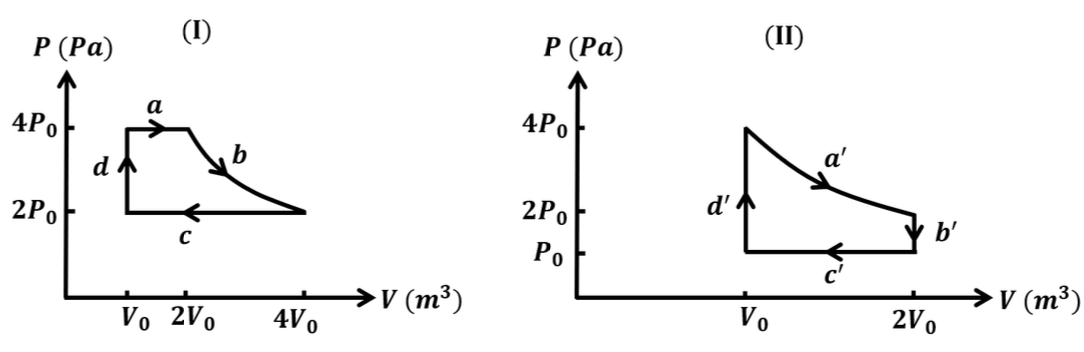
Cycle I. Compute the work on each leg.
Process (isobaric expansion at from to ): .
Process (isothermal from to , with ): .
Process (isobaric compression at from to ): .
Process (isochoric at ): .
.
Cycle II.
Process (isothermal from to , with ): .
Process (isochoric at ): .
Process (isobaric compression at from to ): .
Process (isochoric at ): .
.
Ratio:
.
Concept behind this question
Thermodynamic ProcessesNotes, formulas and examples →More previous year questions on Thermodynamic Processes
Practice more Physics Section 3
Concept-wise practice with instant solutions on Fundamenthol.
Start practicing →