
JEE Advanced 2024 Paper 1, Physics Section 1 Q3: Simple Harmonic Motion And Oscillation
Two beads, each with charge and mass , are on a horizontal, frictionless, non-conducting, circular hoop of radius . One of the beads is glued to the hoop at some point, while the other one performs small oscillations about its equilibrium position along the hoop. The square of the angular frequency of the small oscillations is given by
[ is the permittivity of free space.]
- A
- B
- C
- D
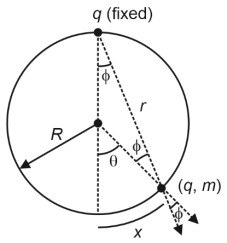
Let the fixed bead sit at the top of the hoop and let the movable bead be located such that the chord between them has length . With being the angle subtended at the centre between the two beads, geometry gives . The arc-length displacement of the free bead from its equilibrium (the point diametrically opposite the fixed bead) is with measured from equilibrium being the natural angular displacement.
Coulomb force along the chord: where .
Only the tangential component (along the hoop) restores the bead. The restoring tangential force has magnitude , and it points opposite to the displacement.
For small oscillations near equilibrium, with small ; expanding shows that the tangential acceleration becomes linear in the small angular displacement and yields the SHM equation
with .
Option (B) is correct.
Concept behind this question
Simple Harmonic Motion And OscillationNotes, formulas and examples →More previous year questions on Simple Harmonic Motion And Oscillation
Practice more Physics Section 1
Concept-wise practice with instant solutions on Fundamenthol.
Start practicing →