
JEE Advanced 2024 Paper 1, Physics Section 2 Q2: Stationary Waves in Air Column
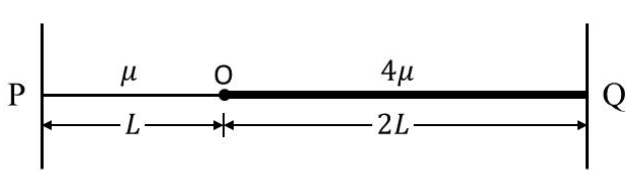
Two uniform strings of mass per unit length and , and length and , respectively, are joined at point , and tied at two fixed ends and , as shown in the figure. The strings are under a uniform tension . If we define the frequency , which of the following statement(s) is(are) correct?
- A
With a node at , the minimum frequency of vibration of the composite string is
- B
With an antinode at , the minimum frequency of vibration of the composite string is
- C
When the composite string vibrates at the minimum frequency with a node at , it has 6 nodes, including the end nodes
- D
No vibrational mode with an antinode at is possible for the composite string
Wave speeds on the two segments: on the left segment (length ) and on the right segment (length ).
Case 1: node at . Each segment then vibrates with both ends as nodes. Allowed frequencies are and for integers . Matching : , i.e. . The minimum is , , giving . Option (A) is correct.
With the left segment has 2 nodes (its endpoints). With the right segment has 5 nodes (its 2 endpoints plus 3 interior nodes). The point is shared, so total distinct nodes . Option (C) is correct.
Case 2: antinode at . Each segment now has a node at the far fixed end and an antinode at . Frequencies are and . Equating: . The right side is odd but the left side is even, so no integer solution exists. Hence no mode can have an antinode at . Option (D) is correct; option (B) is incorrect.
Concept behind this question
Stationary Waves in Air ColumnNotes, formulas and examples →More previous year questions on Stationary Waves in Air Column
Practice more Physics Section 2
Concept-wise practice with instant solutions on Fundamenthol.
Start practicing →