
JEE Advanced 2024 Paper 1, Mathematics Section 4 Q4: Differentiability Of A Function
Let and be functions defined by
and
Let . Define the function by
, .
Match each entry in List-I to the correct entry in List-II.
| List-I | List-II |
|---|---|
| (P) If , , and , then | (1) is one-one |
| (Q) If , , and , then | (2) is onto. |
| (R) If , , and , then | (3) is differentiable on . |
| (S) If , , and , then | (4) the range of is |
| (5) the range of is |
The correct option is
- A
(P) (4); (Q) (3); (R) (1); (S) (2)
- B
(P) (5); (Q) (2); (R) (4); (S) (3)
- C
(P) (5); (Q) (3); (R) (2); (S) (4)
- D
(P) (4); (Q) (2); (R) (1); (S) (3)
Compute for , and otherwise. Therefore
(P) : takes only values . (P) (5).
(Q) at ,
$f'(0^+)=\lim_{h\to 0}\dfrac{f(0+h)-f(0)}{h} =\lim_{h\to 0}\dfrac{h^2\sin\left(\dfrac{1}{h}\right)}{h}$
$f'(0^-)=\lim_{h\to 0}\dfrac{f(0-h)-f(0)}{-h} =\lim_{h\to 0}h\sin\left(\dfrac{1}{h}\right)=0$
As , the function is differentiable at .
Therefore, is differentiable at .
At all other points, is differentiable as it is the product of two differentiable functions. (Q) (3).
(R) : .
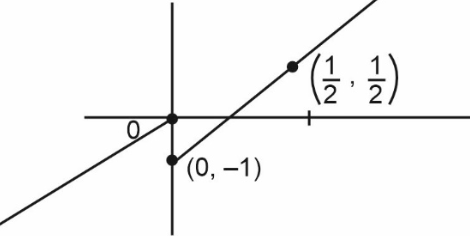
From graph: Range covers all of , and is onto. (R) (2).
(S) : , which takes values in . Range is . (S) (4).
Concept behind this question
Differentiability Of A Function Notes, formulas and examples →More previous year questions on Differentiability Of A Function
Practice more Mathematics Section 4
Concept-wise practice with instant solutions on Fundamenthol.
Start practicing →