
JEE Advanced 2024 Paper 2, Physics Section 4 Q4: SHM in Spring-Mass System
PARAGRAPH II
Two particles, and , each of mass , are connected by a massless spring, and are on a horizontal frictionless plane, as shown in the figure. Initially, the two particles, with their center of mass at , are oscillating with amplitude and angular frequency . Thus, their positions at time are given by and , respectively, where . Particle of mass moves towards this system with speed , and undergoes instantaneous elastic collision with particle , at time . Finally, particles and acquire a center of mass speed and oscillate with amplitude and the same angular frequency .
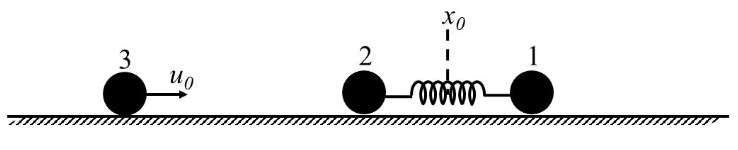
Q2. If the collision occurs at time , then the value of will be __________.
At , , so particle is at extreme position with zero velocity; particle is at , also at rest. The spring is at its maximum stretch (or compression) so both particles are momentarily stationary.
Particle collides elastically with particle (both mass ): velocities are exchanged. Particle acquires velocity rightward; particle remains at rest.
Centre-of-mass velocity of and after collision:
Working in the centre-of-mass frame, the relative coordinate is with zero relative velocity initially; this distance corresponds to one particle at and the other at from the centre of mass. After the collision the relative velocity becomes . In the centre-of-mass frame each particle is at distance from the centre of mass and moving with speed .
For SHM in the COM frame about the relaxed separation, the relation between amplitude , instantaneous position , and speed is . Here each particle has and :
The amplitude of each particle's oscillation about the new centre of mass is , so
Concept behind this question
SHM in Spring-Mass SystemNotes, formulas and examples →More previous year questions on SHM in Spring-Mass System
Practice more Physics Section 4
Concept-wise practice with instant solutions on Fundamenthol.
Start practicing →