
JEE Advanced 2025 Paper 1, Physics Section 1 Q1: Rolling Motion
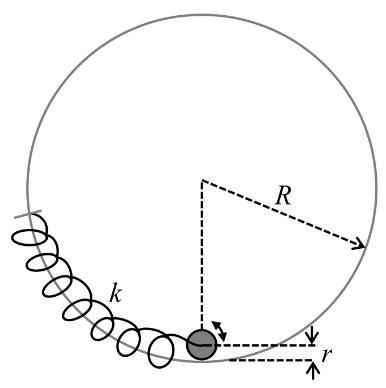
The center of a disk of radius and mass is attached to a spring of spring constant , inside a ring of radius as shown in the figure. The other end of the spring is attached on the periphery of the ring. Both the ring and the disk are in the same vertical plane. The disk can only roll along the inside periphery of the ring, without slipping. The spring can only be stretched or compressed along the periphery of the ring, following the Hooke's law. In equilibrium, the disk is at the bottom of the ring. Assuming small displacement of the disc, the time period of oscillation of center of mass of the disk is written as . The correct expression for is ( is the acceleration due to gravity):
- A
- B
- C
- D
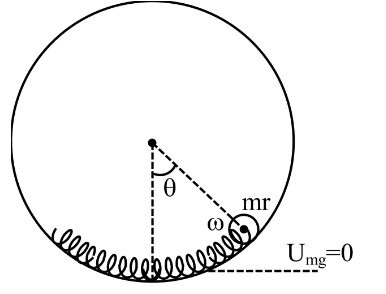
Let be the small angular displacement of the disk's center from the lowest point, measured about the ring center. The arc length displacement of the contact point is , and pure rolling gives the disk's angular velocity about its own center as , where .
Using energy conservation for small oscillations:
For small , use , and the rolling constraint gives the rotational KE as . So the total KE is .
Differentiating with respect to time and dividing through by :
, which matches option (A).
Concept behind this question
Rolling MotionNotes, formulas and examples →More previous year questions on Rolling Motion
Practice more Physics Section 1
Concept-wise practice with instant solutions on Fundamenthol.
Start practicing →