
JEE Advanced 2025 Paper 1, Physics Section 4 Q1: Coulomb's Law And Electric Field
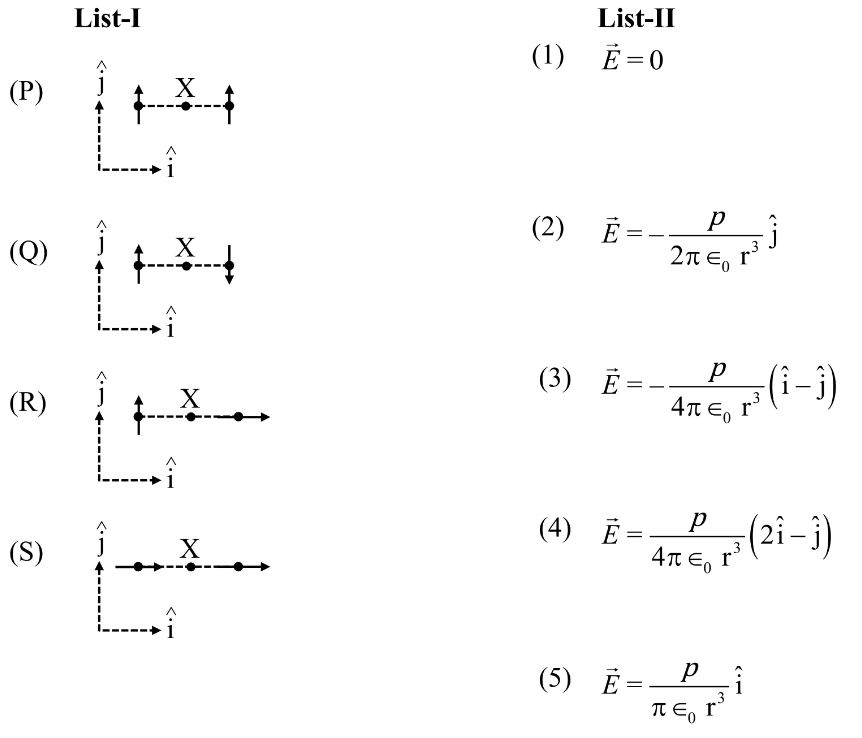
List-I shows four configurations, each consisting of a pair of ideal electric dipoles. Each dipole has a dipole moment of magnitude , oriented as marked by arrows in the figures. In all the configurations the dipoles are fixed such that they are at a distance apart along the direction. The midpoint of the line joining the two dipoles is . The possible resultant electric fields at are given in List-II. Choose the option that describes the correct match between the entries in List-I to those in List-II.
- A
P 3; Q 1; R 2; S 4
- B
P 4; Q 5; R 3; S 1
- C
P 2; Q 1; R 4; S 5
- D
P 2; Q 1; R 3; S 5
The field of an ideal dipole on its equatorial plane is , and on its axis is , with .
(P) Both dipoles point along and lies on their equatorial planes. Each contributes , summing to . Matches (2).
(Q) The two equatorial contributions are equal and opposite (one up, one down), so . Matches (1).
(R) The left dipole (, equatorial point) gives . The right dipole (, axial point) gives . Total: . Matches (4).
(S) Both dipoles point along and sits on the axis of each. Each gives , summing to . Matches (5).
P2, Q1, R4, S5. Option (C).
Concept behind this question
Coulomb's Law And Electric FieldNotes, formulas and examples →More previous year questions on Coulomb's Law And Electric Field
Practice more Physics Section 4
Concept-wise practice with instant solutions on Fundamenthol.
Start practicing →