
JEE Advanced 2025 Paper 2, Mathematics Section 3 Q3: Total Probability Theorem And Bayes' Theorem
A factory has a total of three manufacturing units, , , and , which produce bulbs independent of each other. The units , , and produce bulbs in the proportions of , respectively. It is known that of the bulbs produced in the factory are defective. It is also known that, of all the bulbs produced by , are defective. Suppose that, if a randomly chosen bulb produced in the factory is found to be defective, the probability that it was produced by is .
If a bulb is chosen randomly from the bulbs produced by , then the probability that it is defective is ________.
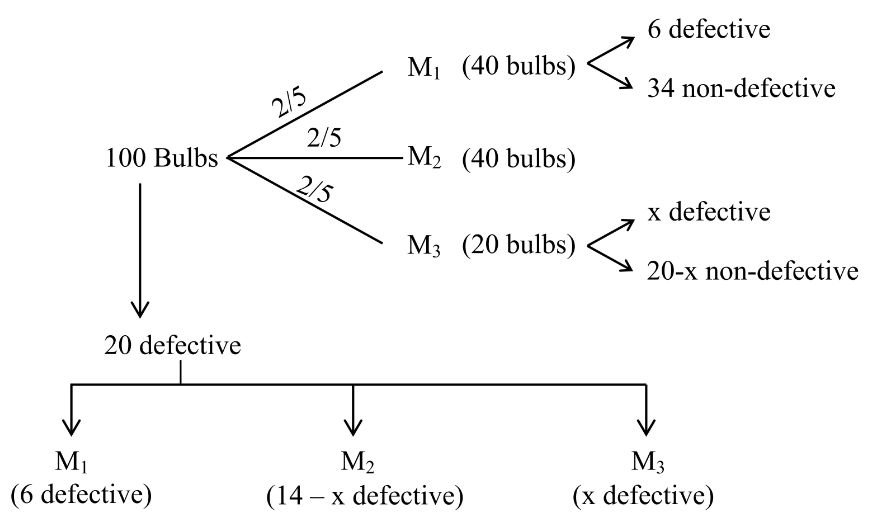
Step 1: Scale to bulbs.
By the production ratio , makes , makes , makes . Total defectives .
Step 2: Defectives from .
of defectives from .
Step 3: Defectives from via Bayes.
, so defectives from .
Step 4: Defectives from .
defectives out of from , giving .
Concept behind this question
Total Probability Theorem And Bayes' TheoremNotes, formulas and examples →More previous year questions on Total Probability Theorem And Bayes' Theorem
Practice more Mathematics Section 3
Concept-wise practice with instant solutions on Fundamenthol.
Start practicing →