
JEE Advanced 2026 Paper 2, Physics Section 4 Q1: Hydrodynamic
Question Stem (Q1-Q2).
A container of height m, length m and breadth m is made of insulating vertical walls and two large area horizontal metal plates ( and ) which extend far beyond the vertical walls in all directions. The container is partitioned into two equal chambers with a thin insulating vertical wall. The partition wall contains a small hole of cross-sectional area cm near its bottom edge. Initially the hole is closed and the left chamber of the container is completely filled with a liquid of dielectric constant and the right chamber is empty (). At time , the hole is opened and the liquid flows from the left chamber to the right chamber. In both the chambers, the space above the liquid has and is maintained at atmospheric pressure. The schematic of the container at a time is shown in the figure. [Given: acceleration due to gravity is ms.]
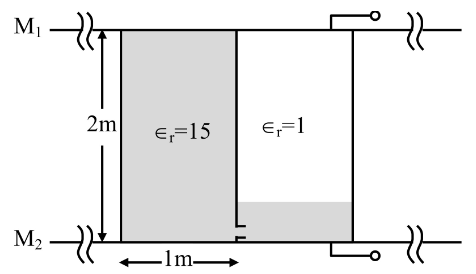
Q1. The height (in m) of the liquid in left chamber at s is:
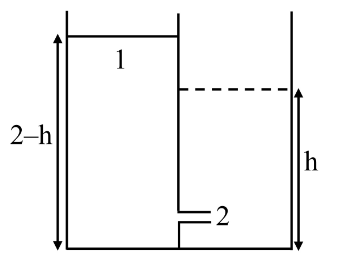
Bernoulli between the top surface of the left chamber (height , point 1) and the hole (point 2, depth below the right surface but bottom of partition).
Let be the height of liquid in the right chamber. The driving head is the difference between the two surfaces, which equals . By Torricelli,
.
Continuity at the hole. Volume rate out of left chamber equals , and equals for the rise in the right (cross-section ). With m and m,
.
Integrate. Separating variables and integrating from to and to :
.
Substitute numbers at s. . So m.
Left chamber height. m.
Concept behind this question
HydrodynamicNotes, formulas and examples →More previous year questions on Hydrodynamic
Practice more Physics Section 4
Concept-wise practice with instant solutions on Fundamenthol.
Start practicing →