
JEE Advanced 2026 Paper 2, Physics Section 4 Q3: Angular Momentum, Its Conservation and Angular Impulse
Question Stem (Q3-Q4).
A uniform circular disk of radius m and mass kg is pivoted at its top point such that it can rotate freely around in the plane, as shown in the figure. Initially, when the disk is at rest, a particle of mass g, travelling along negative direction in the plane with speed ms, hits the circumference of the disk at a point . After collision the particle moves along negative direction at a speed of ms. [Given: the acceleration due to gravity ms]
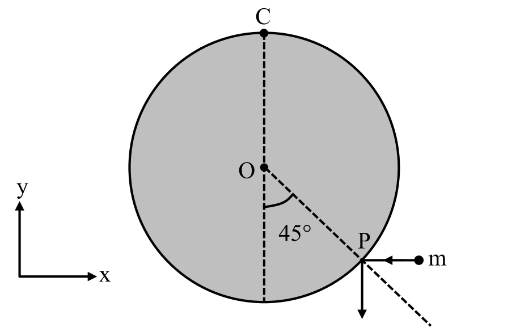
Q3. After the collision the disk starts to rotate around point in the plane. The maximum change in the height (in m) of its center is:
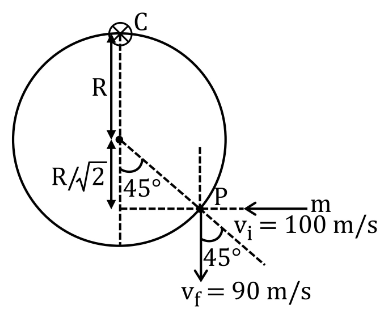
Geometry of P. With at the top, the centre is at distance m below . Since makes with the vertical, lies at horizontal distance from the vertical through and at vertical distance below (using the geometry shown). The perpendicular distance of the incoming horizontal velocity (along ) from equals the vertical drop of below , which is . The perpendicular distance for the outgoing velocity (along ) equals the horizontal distance of from , which is .
Angular momentum about (conserved during the instantaneous collision).
Moment of inertia of the disk about (using parallel axis): kg m.
rad/s.
Maximum rise of from energy conservation. After collision the disk rotates about , and gravity acts on its centre :
, but the relevant quantity is the vertical rise :
m m.
Concept behind this question
Angular Momentum, Its Conservation and Angular ImpulseNotes, formulas and examples →More previous year questions on Angular Momentum, Its Conservation and Angular Impulse
Practice more Physics Section 4
Concept-wise practice with instant solutions on Fundamenthol.
Start practicing →