
JEE Main 2025 Apr 3 Shift 1, Chemistry Q18: Valence Bond Theory And Hybridisation
Match the LIST-I with LIST-II
| LIST-I (Molecules/ion) | LIST-II (Hybridisation of central atom) |
|---|---|
| A. | I. |
| B. | II. |
| C. | III. |
| D. | IV. |
Choose the correct answer from the options given below :
- A
A-II, B-III, C-IV, D-I
- B
A-IV, B-I, C-II, D-III
- C
A-I, B-II, C-III, D-IV
- D
A-III, B-I, C-IV, D-II
: 5 P–F sigma bonds, no lone pair on P. Steric number 5 (trigonal bipyramidal). A → II.
: 6 sigma bonds, no lone pair. Steric number 6 (octahedral). B → III.
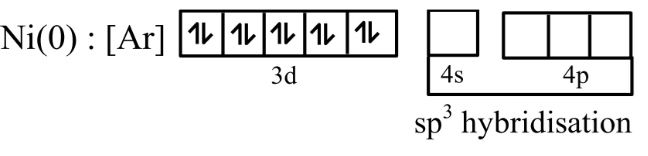
: Ni is in oxidation state 0. CO is a strong field ligand and pairs up the electrons, giving the empty and three orbitals for bonding: (tetrahedral). C → IV.
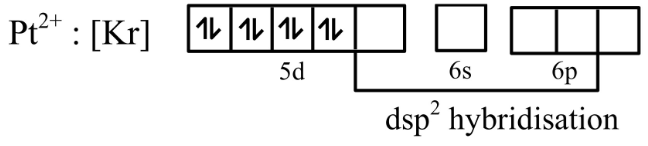
: Pt(II) is a ion. In a strong field of (acting as borderline / strong here due to the 5d nature of Pt), it adopts a square planar geometry using hybridisation. D → I.
Matching: A-II, B-III, C-IV, D-I.
Concept behind this question
Valence Bond Theory And HybridisationNotes, formulas and examples →More previous year questions on Valence Bond Theory And Hybridisation
Practice more Chemistry
Concept-wise practice with instant solutions on Fundamenthol.
Start practicing →