
JEE Main 2025 Jan 29 Shift 2, Physics Q11: Newton's Laws Of Motion
Given below are two statements. One is labelled as Assertion (A) and the other is labelled as Reason (R).
Assertion (A) :
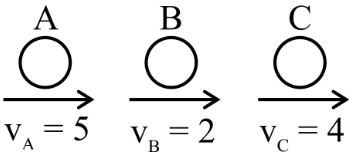
Three identical spheres of same mass undergo one dimensional motion as shown in figure with initial velocities m/s, m/s, m/s. If we wait sufficiently long for elastic collision to happen, then m/s, m/s, m/s will be the final velocities.
Reason (R) : In an elastic collision between identical masses, two objects exchange their velocities.
In the light of the above statements, choose the correct answer from the options given below :
- A
Both (A) and (R) are true but (R) is NOT the correct explanation of (A)
- B
(A) is true but (R) is false
- C
Both (A) and (R) are true and (R) is the correct explanation of (A).
- D
(A) is false but (R) is true
(R) is a standard result for one-dimensional elastic collisions of equal masses: the two participants swap velocities.
Apply this rule to the chain. With ordering and initial velocities (all rightward), A catches B first because .
Collision 1 (A with B): A and B swap velocities. New velocities: .
Now B (moving at ) catches C (moving at ).
Collision 2 (B with C): they swap. Final: .
Comparing with the claimed final values : A and B do not match, so Assertion is false. Reason is true.
Option (4) is correct.
Concept behind this question
Newton's Laws Of MotionNotes, formulas and examples →More previous year questions on Newton's Laws Of Motion
Practice more Physics
Concept-wise practice with instant solutions on Fundamenthol.
Start practicing →