
JEE Main 2026 Apr 4 Shift 2, Chemistry Q4: Colligative Properties
At 27°C, 0.1 M, 1 L K[Fe(CN)] aqueous solution and 0.1 M, 1 L FeCl aqueous solution are placed in a container separated by a semi permeable membrane AB. Assume complete dissociation of both the solutes. Which of the following statement is correct?
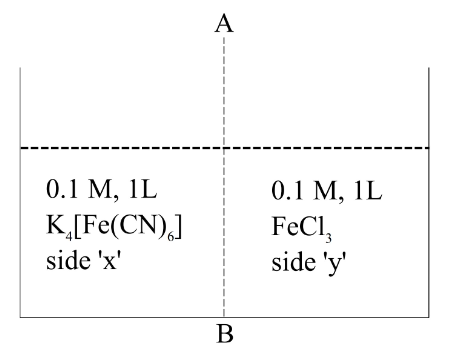
- A
Blue color is formed on both sides.
- B
Ionic solutes in aqueous solution can pass through semi-permeable membrane.
- C
Solution on side 'y' is hypotonic.
- D
To cause the reverse flow of solvent during osmosis, external pressure (any value) should be applied to side 'x'.
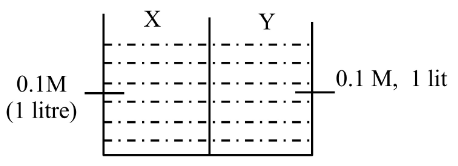
A semi-permeable membrane allows only solvent (water) to pass, not the dissociated ions.
van't Hoff factors (complete dissociation): K[Fe(CN)] 4K + [Fe(CN)], . FeCl Fe + 3Cl, .
Effective particle concentrations: side x M; side y M. So side x is hypertonic and side y is hypotonic.
Statement-wise:
(1) Wrong — Prussian blue forms only if Fe and [Fe(CN)] mix, which they cannot across an SPM.
(2) Wrong — ions cannot cross an SPM.
(3) Correct — side y has lower osmotic pressure and is hypotonic.
(4) Wrong — reverse osmosis requires external pressure on the hypertonic side (x), but the pressure must exceed the osmotic pressure difference, not "any value".
Concept behind this question
Colligative PropertiesNotes, formulas and examples →More previous year questions on Colligative Properties
Practice more Chemistry
Concept-wise practice with instant solutions on Fundamenthol.
Start practicing →