
JEE Main 2026 Jan 23 Shift 2, Chemistry Q20: Analysis of Amines
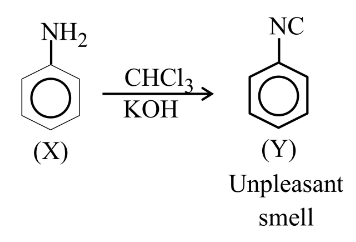
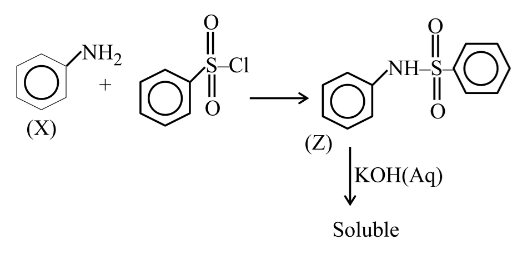
A student has been given a compound "x" of molecular formula . 'x' is sparingly soluble in water. However, on addition of dilute mineral acid, 'x' becomes soluble in water. 'x' when treated with and KOH (alc.) 'y' is produced. 'y' has a specific unpleasant smell. On treatment with benzenesulphonyl chloride, 'x' gives a compound 'z' which is soluble in alkali. The number of different "H" atoms present in 'z' is:-
- A
5
- B
8
- C
4
- D
7
with the given behaviour is aniline ():
- Sparingly soluble in water but soluble in dilute (forms anilinium salt).
- With (carbylamine reaction), aniline gives phenyl isocyanide (offensive smell) → this confirms a primary amine.
- With benzenesulphonyl chloride (Hinsberg test), aniline gives -phenyl benzenesulphonamide (), which is soluble in alkali because of the acidic .
Counting distinct H environments in (compound z):
- : 1 type
- Aniline ring (attached to NH): ortho, meta, para = 3 types
- Sulphonyl ring (attached to ): ortho, meta, para = 3 types
Total = different hydrogen environments.
Concept behind this question
Analysis of AminesNotes, formulas and examples →More previous year questions on Analysis of Amines
Practice more Chemistry
Concept-wise practice with instant solutions on Fundamenthol.
Start practicing →