
JEE Advanced 2022 Paper 1, Physics Section 3 Q2: Motion In Two And Three Dimension
List I describes four systems, each with two particles and in relative motion as shown in figures. List II gives possible magnitude of their relative velocities (in m s) at time s.
| List-I | List-II |
|---|---|
(I) and are moving on a horizontal circle of radius 1 m with uniform angular speed rad s. The initial angular positions of and at time are and , respectively.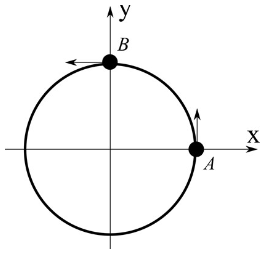 | (P) |
(II) Projectiles and are fired (in the same vertical plane) at and s respectively, with the same speed ms and at from the horizontal plane. The initial separation between and is large enough so that they do not collide ( ms).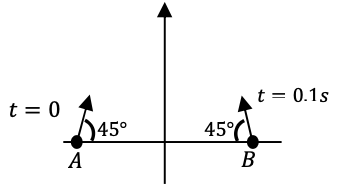 | (Q) |
(III) Two harmonic oscillators and moving in the direction according to and respectively, starting from . Take m, s.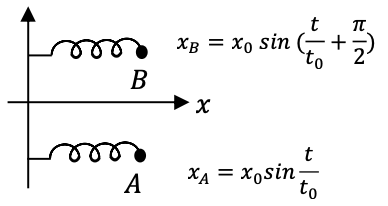 | (R) |
(IV) Particle is rotating in a horizontal circular path of radius 1 m on the plane, with constant angular speed rad s. Particle is moving up at a constant speed 3 ms in the vertical direction as shown in the figure. (Ignore gravity.)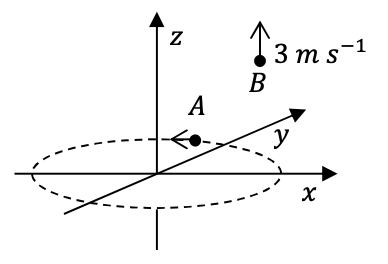 | (S) |
| (T) |
Which one of the following options is correct?
- A
I R, II T, III P, IV S
- B
I S, II P, III Q, IV R
- C
I S, II T, III P, IV R
- D
I T, II P, III R, IV S
(I) Both particles move on the same circle with the same speed m/s but their velocity vectors are perpendicular (since their positions differ by always). Relative speed = m/s. I S.
(II) Both projectiles experience the same gravitational acceleration, so the relative velocity is constant in time once both have launched (for s). At s (just after launches), velocities are: , and (oppositely directed horizontal component). Relative velocity , magnitude . II T.
(III) . Relative velocity . At : . III P.
(IV) 's speed is m/s (horizontal); 's speed is 3 m/s (vertical). Velocities are perpendicular. Relative speed . IV R.
The correct matching is option (C).
Concept behind this question
Motion In Two And Three DimensionNotes, formulas and examples →More previous year questions on Motion In Two And Three Dimension
Practice more Physics Section 3
Concept-wise practice with instant solutions on Fundamenthol.
Start practicing →