
JEE Advanced 2022 Paper 1, Chemistry Section 3 Q1: Reactions of Various Orders
Match the rate expressions in LIST-I for the decomposition of X with the corresponding profiles provided in LIST-II. and are constants having appropriate units.
| LIST-I | LIST-II |
|---|---|
| (I) under all possible initial concentrations of X | (P) 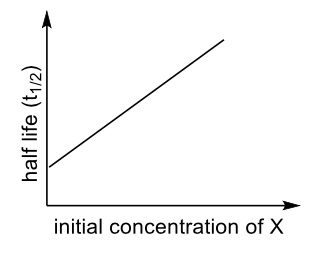 |
| (II) where initial concentrations of X are much less than | (Q) 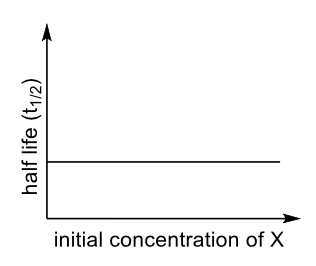 |
| (III) where initial concentrations of X are much higher than | (R) 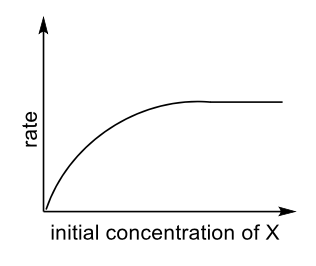 |
| (IV) where initial concentration of X is much higher than | (S) 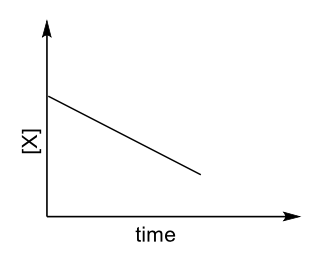 |
(T) 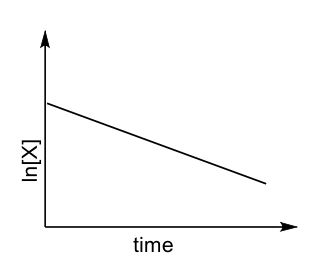 |
Which one of the following options is correct?
- A
I P; II Q; III S; IV T
- B
I R; II S; III S; IV T
- C
I P; II Q; III Q; IV R
- D
I R; II S; III Q; IV R
This is Michaelis-Menten-type kinetics. Two limits matter:
Limit A: . The denominator , so rate . Zero-order kinetics: decreases linearly with time, and the half-life is proportional to (a straight line through the origin).
Limit B: . The denominator , so rate . First-order kinetics: vs is a straight line with negative slope, and half-life is independent of .
(I) No limit imposed. As varies from very large to small, rate transitions from zero-order to first-order behaviour. The rate vs plot shows a saturating curve, and the half-life vs plot in the high-concentration zero-order regime is a straight line through the origin. The single best match capturing the full behaviour is P (half-life linear in , the zero-order saturating regime).
(II) : pseudo-first-order. Half-life is constant. II Q.
(III) : zero order. vs is a straight line with negative slope. III S.
(IV) with : rate , i.e., first-order. vs is linear with negative slope. IV T.
The correct matching is option (A).
Concept behind this question
Reactions of Various OrdersNotes, formulas and examples →More previous year questions on Reactions of Various Orders
Practice more Chemistry Section 3
Concept-wise practice with instant solutions on Fundamenthol.
Start practicing →