
JEE Advanced 2022 Paper 1, Mathematics Section 3 Q4: Ellipse: Chord, Tangent and Normal
Consider the ellipse
Let , , be a point. A straight line drawn through parallel to the -axis crosses the ellipse and its auxiliary circle at points and respectively, in the first quadrant. The tangent to the ellipse at the point intersects the positive -axis at a point . Suppose the straight line joining and the origin makes an angle with the positive -axis.
| List-I | List-II |
|---|---|
| (I) If , then the area of the triangle is | (P) |
| (II) If , then the area of the triangle is | (Q) |
| (III) If , then the area of the triangle is | (R) |
| (IV) If , then the area of the triangle is | (S) |
| (T) |
The correct option is:
- A
(I) (R); (II) (S); (III) (Q); (IV) (P)
- B
(I) (R); (II) (T); (III) (S); (IV) (P)
- C
(I) (Q); (II) (T); (III) (S); (IV) (P)
- D
(I) (Q); (II) (S); (III) (Q); (IV) (P)
The ellipse has semi-axes , . Its auxiliary circle is . With , the vertical line through meets the auxiliary circle at in the first quadrant. Writing (where is the eccentric angle), .
On the ellipse the corresponding point is .
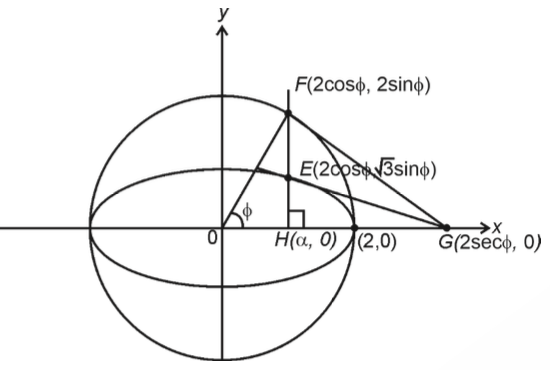
Tangent at to the ellipse: . Setting gives .
Triangle is right-angled at , with horizontal leg , vertical leg .
(I) : . (Q).
(II) : . (T).
(III) : . (S).
(IV) : Using and , . Compute (using the identity which follows from ). (P).
Matching: (I) (Q); (II) (T); (III) (S); (IV) (P), which is option (C).
Concept behind this question
Ellipse: Chord, Tangent and NormalNotes, formulas and examples →More previous year questions on Ellipse: Chord, Tangent and Normal
Practice more Mathematics Section 3
Concept-wise practice with instant solutions on Fundamenthol.
Start practicing →