
JEE Advanced 2023 Paper 1, Physics Section 1 Q1: Work Energy Theorem And Its Applications
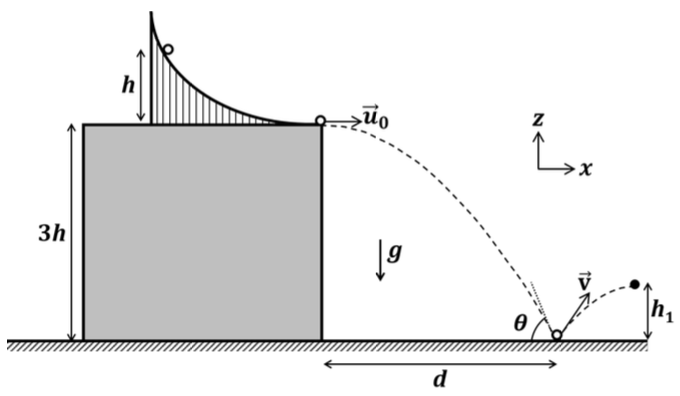
A slide with a frictionless curved surface, which becomes horizontal at its lower end, is fixed on the terrace of a building of height from the ground, as shown in the figure. A spherical ball of mass is released on the slide from rest at a height from the top of the terrace. The ball leaves the slide with a velocity and falls on the ground at a distance from the building making an angle with the horizontal. It bounces off with a velocity and reaches a maximum height . The acceleration due to gravity is and the coefficient of restitution of the ground is . Which of the following statement(s) is(are) correct?
- A
- B
- C
- D
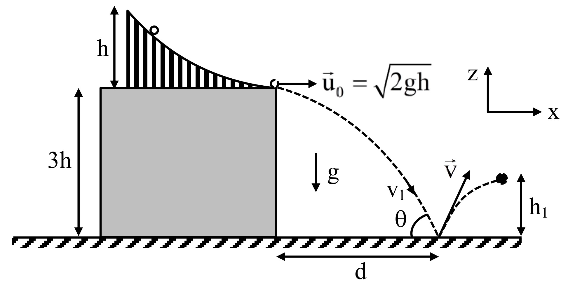
Velocity at the bottom of the slide. Energy conservation on the frictionless slide from rest at height gives , directed along . Hence , so option (A) holds.
Velocity just before impact. Horizontal component is unchanged: . Vertical drop is , so .
Angle of incidence. . Option (C) holds.
Bounce. Horizontal component is preserved (smooth ground); vertical component reverses and scales by : . So , which does not match option (B).
Maximum height after bounce. .
Horizontal range from building base. Time of flight , so .
. Option (D) holds.
Correct options: (A), (C), (D).
Concept behind this question
Work Energy Theorem And Its ApplicationsNotes, formulas and examples →More previous year questions on Work Energy Theorem And Its Applications
Practice more Physics Section 1
Concept-wise practice with instant solutions on Fundamenthol.
Start practicing →