
JEE Advanced 2023 Paper 1, Physics Section 1 Q2: Prism
A plane polarized blue light ray is incident on a prism such that there is no reflection from the surface of the prism. The angle of deviation of the emergent ray is (see Figure-1). The angle of minimum deviation for red light from the same prism is (see Figure-2). The refractive index of the prism material for blue light is . Which of the following statement(s) is(are) correct?
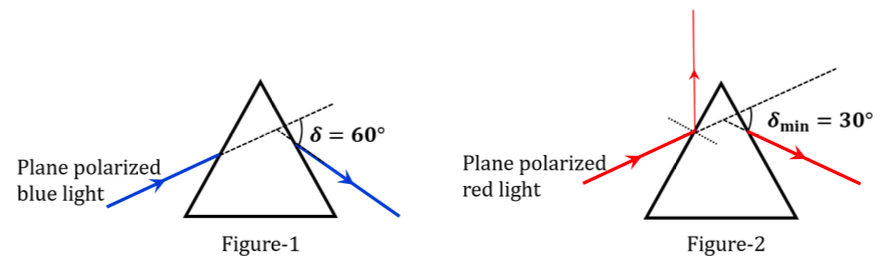
- A
The blue light is polarized in the plane of incidence.
- B
The angle of the prism is .
- C
The refractive index of the material of the prism for red light is .
- D
The angle of refraction for blue light in air at the exit plane of the prism is .
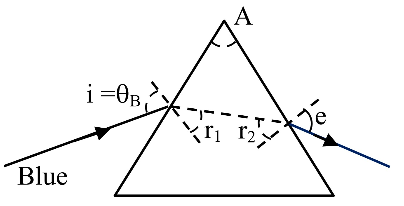
Polarization condition. Zero reflection at the entry face means the blue light is incident at Brewster's angle and is polarized in the plane of incidence (p-polarized). Hence option (A) is correct.
Angle of incidence for blue light. Brewster's law gives , so .
Refraction at entry face. Using Snell's law: .
Geometry of the prism. With prism angle , and the total deviation . So . Snell's law at exit: , i.e. . Expanding: , giving , so and .
Therefore the exit angle in air is , confirming option (D). Option (B) (which claims ) is incorrect.
Refractive index for red light. At minimum deviation with and : . Option (C) holds.
Correct options: (A), (C), (D).
Concept behind this question
PrismNotes, formulas and examples →More previous year questions on Prism
Practice more Physics Section 1
Concept-wise practice with instant solutions on Fundamenthol.
Start practicing →