
JEE Advanced 2026 Paper 2, Physics Section 2 Q1: Prism
Consider two isosceles prisms 1 and 2 with prism angles and and refractive indices and , respectively, as shown in the figure. The faces and are parallel to each other and perpendicular to the mirror . If a ray of light is incident on the face and emerges from the face , then the correct statement(s) is/are:
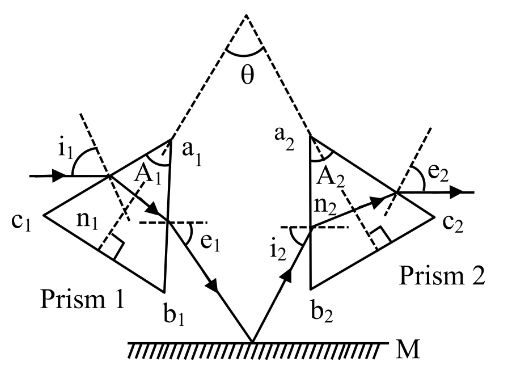
- A
If both the prisms are at minimum deviation condition, then
- B
If prism 2 is at minimum deviation condition, then is always true.
- C
If both the prisms 1 and 2 are thin and are at minimum deviation condition with angles of deviation and , respectively, then .
- D
If prism 1 is at minimum deviation condition, then is always true.
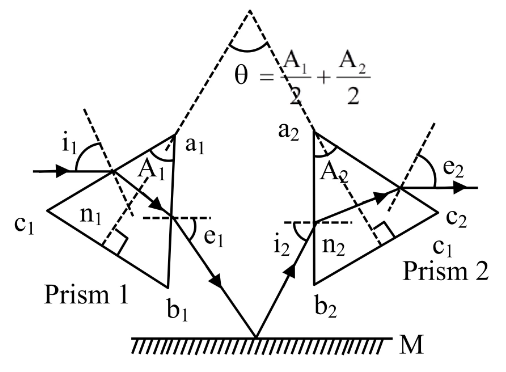
Geometry. Because the vertical faces and are perpendicular to the mirror, the ray inside prism 1 reflects off the mirror and enters prism 2 symmetrically. The construction forces . The minimum-deviation condition on a single prism is for that prism alone.
Option (A). At minimum deviation for prism 1: . At minimum deviation for prism 2: . By the symmetry , so
. Correct.
Option (B). If only prism 2 is at minimum deviation, but prism 1 need not be at minimum deviation, so in general. Thus is not always true. Incorrect.
Option (D). If prism 1 is at minimum deviation, , and by geometry , so . Correct.
Option (C). For thin prisms at minimum deviation, and . The angle between the two outward faces is , hence
. Correct.
Correct options are (A), (C), (D).
Concept behind this question
PrismNotes, formulas and examples →More previous year questions on Prism
Practice more Physics Section 2
Concept-wise practice with instant solutions on Fundamenthol.
Start practicing →