
JEE Advanced 2023 Paper 1, Chemistry Section 1 Q2: Stereoisomerism
In the following reactions, P, Q, R, and S are the major products.
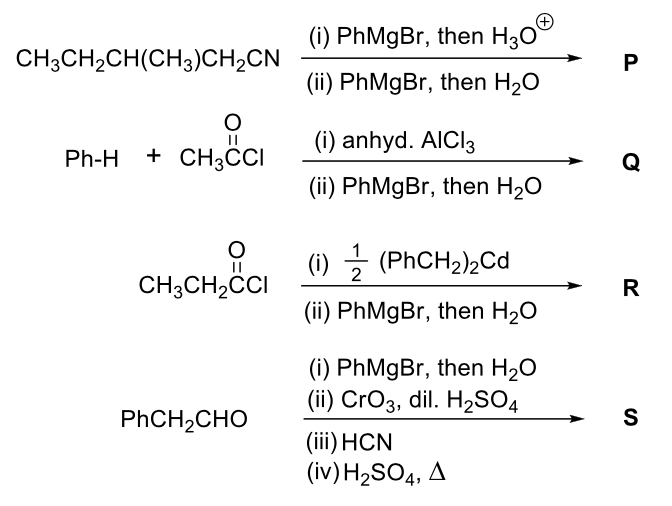
The correct statement(s) about P, Q, R, and S is(are)
- A
Both P and Q have asymmetric carbon(s).
- B
Both Q and R have asymmetric carbon(s).
- C
Both P and R have asymmetric carbon(s).
- D
P has asymmetric carbon(s), S does not have any asymmetric carbon.
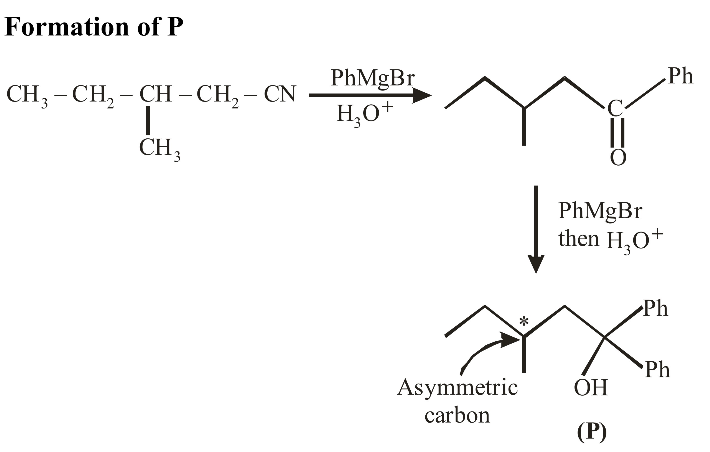
Product P. The nitrile reacts with PhMgBr (followed by acidic workup) to give the corresponding ketone . A second equivalent of PhMgBr adds to the ketone to give the tertiary alcohol . The original bearing the methyl branch is bonded to four distinct groups (ethyl, methyl, H, ) and is therefore asymmetric. P has an asymmetric carbon.
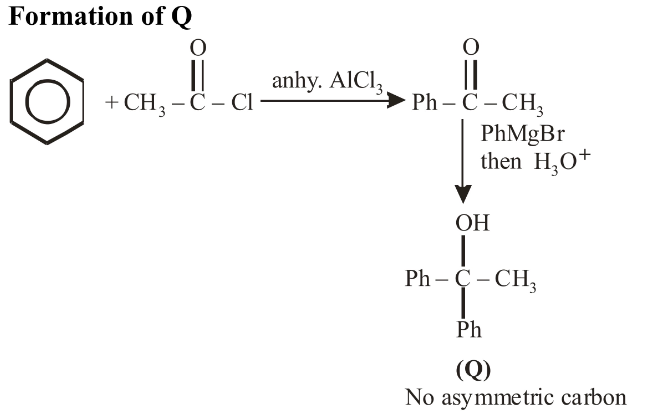
Product Q. Friedel-Crafts acylation of benzene with acetyl chloride gives acetophenone (). Addition of PhMgBr gives 1,1-diphenylethanol, . The central carbon bears two identical phenyl groups, so it is not a stereocentre. Q has no asymmetric carbon.
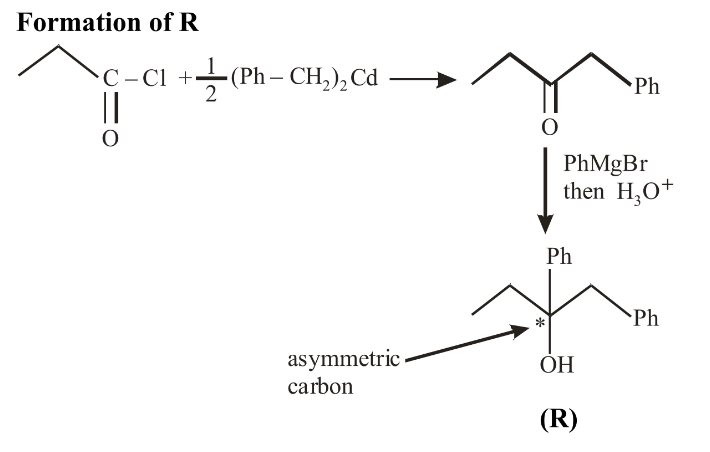
Product R. The organocadmium converts propionyl chloride to the ketone . Addition of PhMgBr yields . The carbinol carbon is bonded to ethyl, phenyl, benzyl and OH, four different groups. R has an asymmetric carbon.
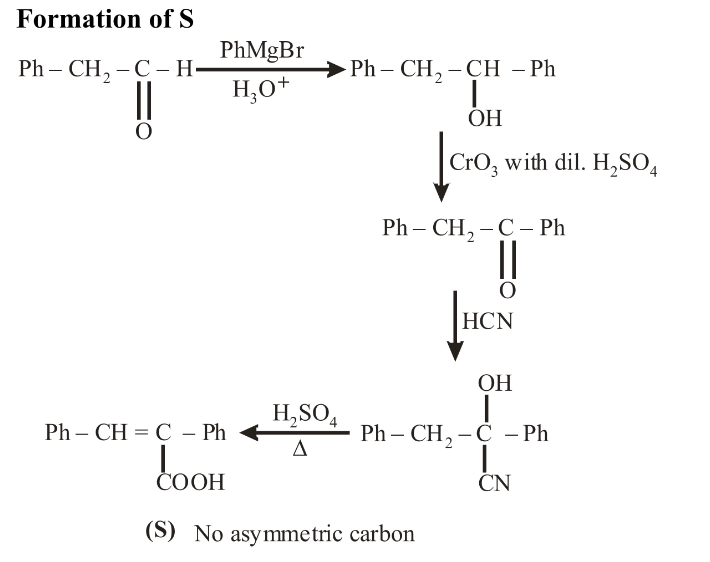
Product S. PhCHCHO + PhMgBr gives the secondary alcohol ; CrO/dil. HSO oxidises this to the ketone . HCN addition produces the cyanohydrin , which on dehydration with conc. and hydrolysis gives the unsaturated acid (an -unsaturated acid with both sp carbons). S has no asymmetric carbon.
Conclusion. Asymmetric centres are present in P and R only; therefore options (C) and (D) are correct.
Correct options: (C), (D).
Concept behind this question
StereoisomerismNotes, formulas and examples →More previous year questions on Stereoisomerism
Practice more Chemistry Section 1
Concept-wise practice with instant solutions on Fundamenthol.
Start practicing →