
JEE Advanced 2023 Paper 1, Chemistry Section 4 Q2: Colour, Magnetism And Stability Of Co-ordination Compounds
Match the electronic configurations in List-I with appropriate metal complex ions in List-II and choose the correct option.
[Atomic Number: Fe = 26, Mn = 25, Co = 27]
| List-I | List-II |
|---|---|
| (P) | (1) [Fe(HO)] |
| (Q) | (2) [Mn(HO)] |
| (R) | (3) [Co(NH)] |
| (S) | (4) [FeCl] |
| (5) [CoCl] |
- A
P 1; Q 4; R 2; S 3
- B
P 1; Q 2; R 4; S 5
- C
P 3; Q 2; R 5; S 1
- D
P 3; Q 2; R 4; S 1
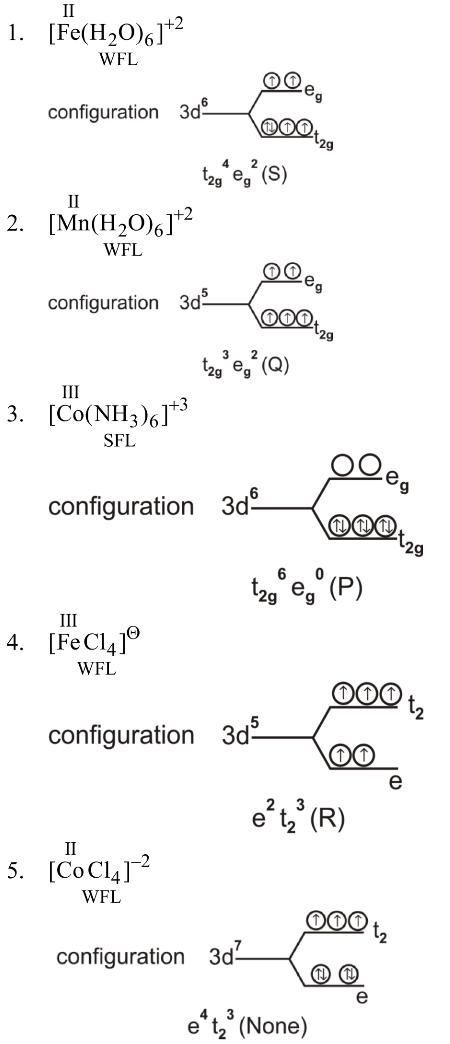
Determine the -electron count and field-splitting for each octahedral or tetrahedral complex.
[Fe(HO)]. Fe is ; HO is a weak-field ligand, so the high-spin octahedral configuration is (matches S).
[Mn(HO)]. Mn is ; with HO (weak field) it is high spin: (matches Q).
[Co(NH)]. Co is ; NH is a strong-field ligand, so low spin in octahedral geometry gives (matches P).
[FeCl]. Fe is in a tetrahedral field. The tetrahedral splitting puts the set below ; weak-field high spin gives (matches R).
[CoCl]. Co is in tetrahedral field, configuration . This does not appear in List-I.
Mapping: P 3, Q 2, R 4, S 1. Answer: (D).
Concept behind this question
Colour, Magnetism And Stability Of Co-ordination CompoundsNotes, formulas and examples →More previous year questions on Colour, Magnetism And Stability Of Co-ordination Compounds
Practice more Chemistry Section 4
Concept-wise practice with instant solutions on Fundamenthol.
Start practicing →