
JEE Advanced 2023 Paper 2, Physics Section 2 Q2: Angular Momentum, Its Conservation and Angular Impulse
An annular disk of mass , inner radius and outer radius is placed on a horizontal surface with coefficient of friction , as shown in the figure. At some time, an impulse is applied at a height above the center of the disk. If then the disk rolls without slipping along the -axis. Which of the following statement(s) is(are) correct?
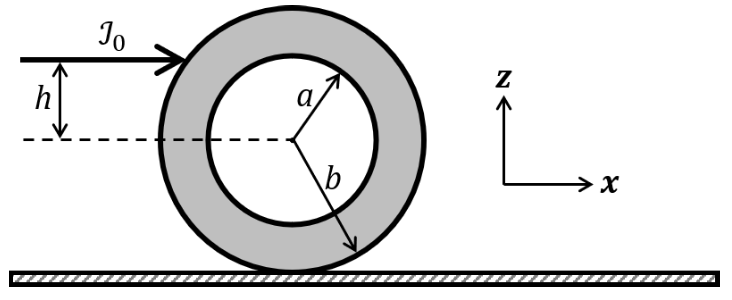
- A
For and ,
- B
For and ,
- C
For , the initial angular velocity does not depend on the inner radius .
- D
For and , the wheel always slides without rolling.
Apply the impulse equations about the centre of mass. The linear impulse gives
,
and the angular impulse about the centre gives
,
where for the annular disk about its symmetry axis.
The condition for rolling without slipping right after the impulse is . Combining the three relations,
.
(A) As : .
(B) As : .
(C) The initial angular velocity is , which contains nowhere.
(D) If and , the impulse passes through the centre, producing zero torque. No angular velocity is generated and friction is absent, so the wheel translates without rotating, that is, it slides.
All four options are correct.
Concept behind this question
Angular Momentum, Its Conservation and Angular ImpulseNotes, formulas and examples →More previous year questions on Angular Momentum, Its Conservation and Angular Impulse
Practice more Physics Section 2
Concept-wise practice with instant solutions on Fundamenthol.
Start practicing →