
JEE Advanced 2023 Paper 2, Physics Section 2 Q1: Interference by Thin Film
A monochromatic light wave is incident normally on a glass slab of thickness , as shown in the figure. The refractive index of the slab increases linearly from to over the height . Which of the following statement(s) is (are) true about the light wave emerging out of the slab?
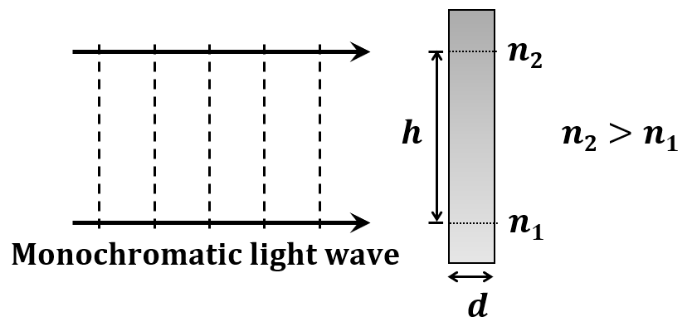
- A
It will deflect up by an angle
- B
It will deflect up by an angle
- C
It will not deflect.
- D
The deflection angle depends only on and not on the individual values of and .
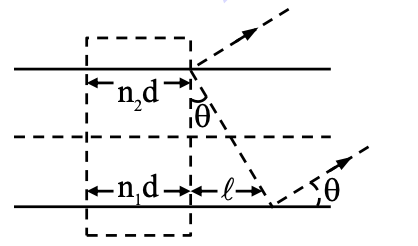
Consider two extreme rays of the same incident wavefront: one travelling along the top edge of the slab (refractive index ) and one along the bottom edge (). Both traverse the same geometric thickness , but they accumulate different optical path lengths and .
The top ray is retarded relative to the bottom ray. After exit, the wavefront tilts: along the height of the wavefront, there is a sideways shift given by matching optical paths,
.
The tilt angle of the emergent wavefront with respect to the original direction satisfies
.
Since the top of the slab has the higher index, the wave bends upward, towards the denser region. The result depends solely on the difference , justifying option (D) as well.
Concept behind this question
Interference by Thin FilmNotes, formulas and examples →More previous year questions on Interference by Thin Film
Practice more Physics Section 2
Concept-wise practice with instant solutions on Fundamenthol.
Start practicing →