
JEE Advanced 2023 Paper 2, Chemistry Section 2 Q3: Naming of Carboxylic acids & Its Derivatives
In the following reactions, P, Q, R, and S are the major products.
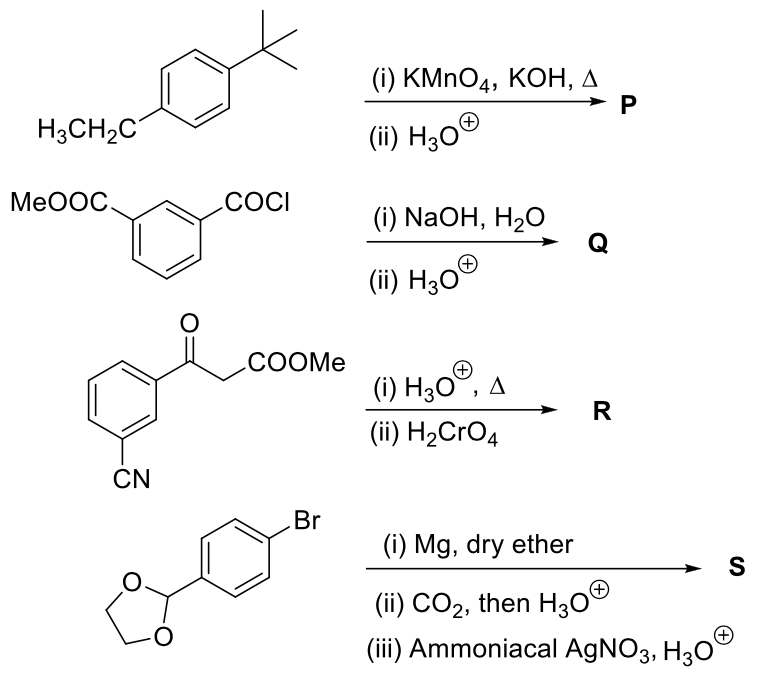
The correct statement(s) about P, Q, R, and S is (are)
- A
P and Q are monomers of polymers dacron and glyptal, respectively.
- B
P, Q, and R are dicarboxylic acids.
- C
Compounds Q and R are the same.
- D
R does not undergo aldol condensation and S does not undergo Cannizzaro reaction.
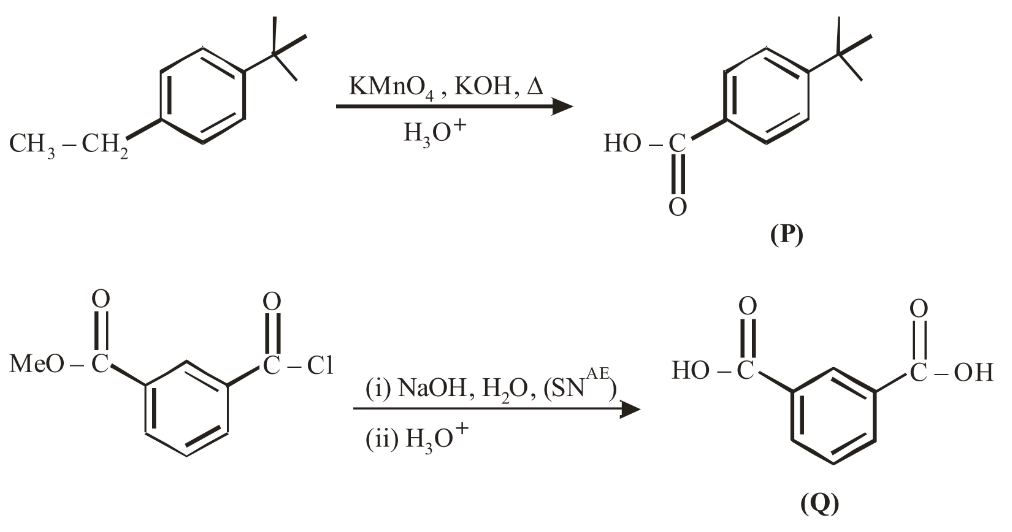
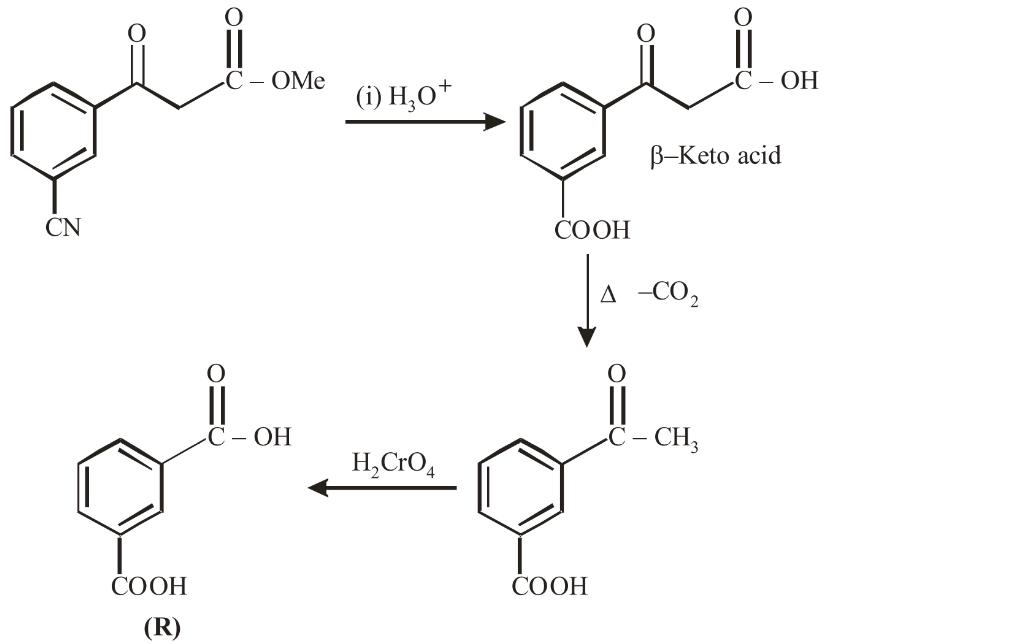
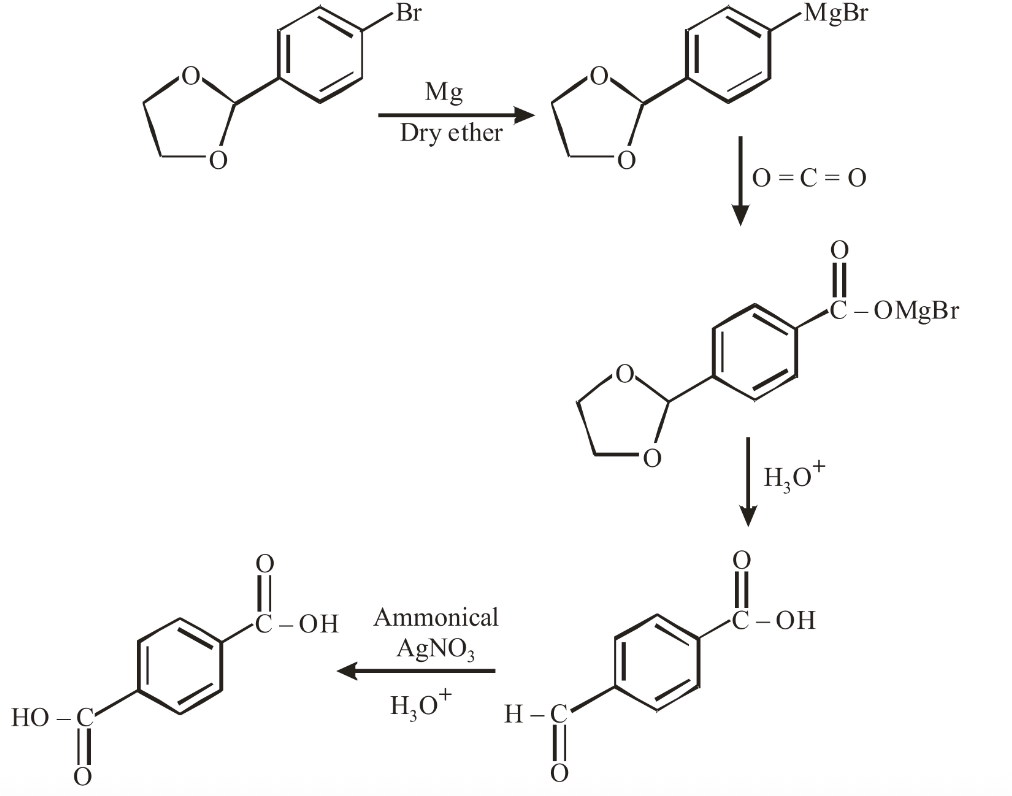
Identify the products.
P: Hot alkaline oxidises only the side chain with benzylic hydrogens. The ethyl group is oxidised to while the -butyl group (no benzylic H) is left untouched. After acidic workup, P is 4-tert-butylbenzoic acid, a monocarboxylic acid.
Q: Aqueous hydrolyses both the acid chloride and the methyl ester at the meta positions. Acidic workup gives benzene-1,3-dicarboxylic acid (isophthalic acid).
R: Acid hydrolysis of the methyl ester gives a -keto acid that decarboxylates on heating to leave a methyl ketone with the spectator . Oxidation by converts the methyl ketone to a second carboxyl group, again furnishing isophthalic acid.
S: The bromoarene forms a Grignard that adds to to give a benzoic acid bearing and the protected aldehyde. Tollens reagent (ammoniacal ) hydrolyses the cyclic acetal to the aldehyde and simultaneously oxidises the aldehyde to a carboxylic acid; the nitrile also hydrolyses to a carboxylic acid under prolonged aqueous conditions. The final product S is a tricarboxylic aromatic acid (no aldehyde remaining).
Evaluate each option.
(A) Wrong. Dacron uses terephthalic acid (1,4) with ethylene glycol; glyptal uses phthalic acid (1,2) with glycerol. P is 4-tert-butylbenzoic acid and Q is isophthalic acid (1,3); neither is the monomer of dacron or glyptal.
(B) Wrong. P is a monocarboxylic acid, so the claim that P, Q, R are all dicarboxylic acids fails.
(C) Correct. Both Q and R are isophthalic acid.
(D) Correct. R (isophthalic acid) has no -hydrogens, so no aldol condensation is possible. S, having no aldehyde group, does not undergo Cannizzaro.
Correct options: (C) and (D).
Concept behind this question
Naming of Carboxylic acids & Its DerivativesNotes, formulas and examples →More previous year questions on Naming of Carboxylic acids & Its Derivatives
Practice more Chemistry Section 2
Concept-wise practice with instant solutions on Fundamenthol.
Start practicing →