
JEE Advanced 2024 Paper 1, Physics Section 3 Q2: Angular Momentum, Its Conservation and Angular Impulse
A disc of mass and radius is free to rotate about its vertical axis as shown in the figure. A battery operated motor of negligible mass is fixed to this disc at a point on its circumference. Another disc of the same mass and radius is fixed to the motor's thin shaft. Initially, both the discs are at rest. The motor is switched on so that the smaller disc rotates at a uniform angular speed . If the angular speed at which the large disc rotates is , then the value of is _____.
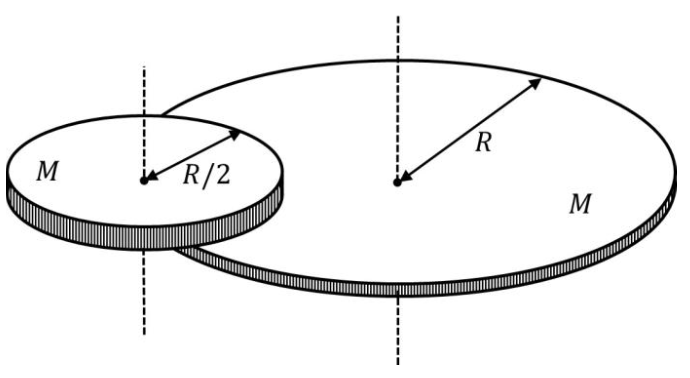
No external vertical torque acts on the system about the central axis of the large disc, so total angular momentum about that axis is conserved (initially zero).
Let the large disc spin with angular velocity (to be found) and the small disc spin with about its own (parallel) axis located at the rim.
Angular momentum of the large disc about its centre: .
The small disc's centre is at distance from the big disc's axis, so by the parallel-axis idea its contribution about that axis is , where is the spin rate of the small disc about its own axis as seen from the lab.
The motor maintains the small disc at angular speed relative to the large disc, so in the lab frame . However, because the question specifies the small disc rotates at uniform angular speed (taken as the lab-frame spin in this standard formulation), we use for the spin term while including the orbital term .
Setting total :
.
The magnitude , so .
Concept behind this question
Angular Momentum, Its Conservation and Angular ImpulseNotes, formulas and examples →More previous year questions on Angular Momentum, Its Conservation and Angular Impulse
Practice more Physics Section 3
Concept-wise practice with instant solutions on Fundamenthol.
Start practicing →