
JEE Advanced 2024 Paper 1, Physics Section 4 Q1: Thermodynamic Processes
One mole of a monatomic ideal gas undergoes the cyclic process , as shown in the P-T diagram.
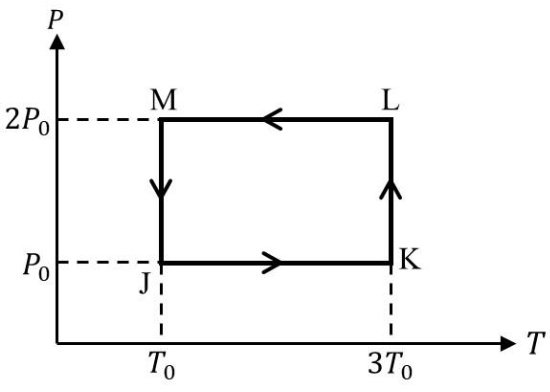
Match the quantities mentioned in List-I with their values in List-II and choose the correct option.
[ is the gas constant.]
| List-I | List-II |
|---|---|
| (P) Work done in the complete cyclic process | (1) |
| (Q) Change in the internal energy of the gas in the process | (2) |
| (R) Heat given to the gas in the process | (3) |
| (S) Change in the internal energy of the gas in the process | (4) |
| (5) |
- A
P 1; Q 3; R 5; S 4
- B
P 4; Q 3; R 5; S 2
- C
P 4; Q 1; R 2; S 2
- D
P 2; Q 5; R 3; S 4
Identify each leg from the P-T diagram. Note that constant-P legs on a P-T plot are horizontal lines, and a constant-T leg is vertical. With mole, .
J K (isobaric at , ): , .
K L ( to in P-T means isothermal): In a P-T diagram, the segment KL goes from to . Temperature constant means this is an isothermal process where pressure doubles, hence volume halves. For an isothermal: , , so .
L M (isobaric at , ): , .
M J (isothermal at , , volume doubles): , .
Net cyclic work: . So P 4.
Q 3.
R 5.
S 2.
Option (B) is correct.
Concept behind this question
Thermodynamic ProcessesNotes, formulas and examples →More previous year questions on Thermodynamic Processes
Practice more Physics Section 4
Concept-wise practice with instant solutions on Fundamenthol.
Start practicing →