
JEE Advanced 2024 Paper 1, Chemistry Section 2 Q2: Properties and Important Reactions of Aldehydes & Ketones
Reaction of iso-propylbenzene with followed by the treatment with forms phenol and a by-product P. Reaction of P with 3 equivalents of gives compound Q. Treatment of Q with produces compound R and calcium salt S.
The correct statement(s) regarding P, Q, R and S is(are)
- A
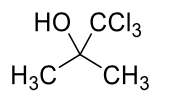
Reaction of P with R in the presence of KOH followed by acidification gives
- B
Reaction of R with in the presence of light gives phosgene gas
- C
Q reacts with aqueous NaOH to produce and
- D
S on heating gives P
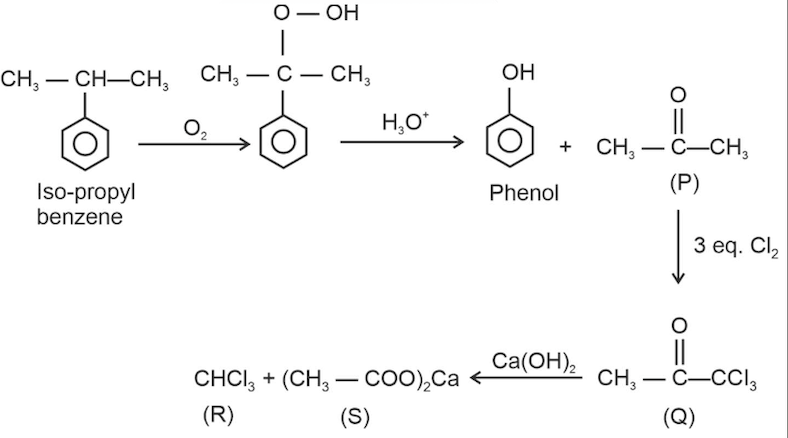
The Hock (cumene) process: cumene + O then HO gives phenol and acetone (P = ).
Treatment of acetone with 3 equivalents of Cl chlorinates only the methyl groups on one side completely, giving 1,1,1-trichloroacetone (Q = ).
With Ca(OH), the haloform-type cleavage occurs: splits to give R = CHCl (chloroform) and the calcium salt of acetate, S = .
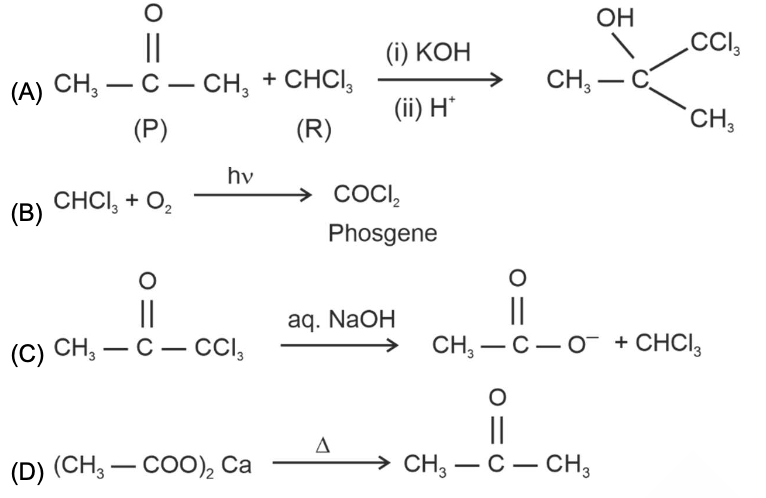
(A) Acetone + CHCl with KOH (base-catalysed addition of the trichloromethyl carbanion to the carbonyl) gives, after acidification, 1,1,1-trichloro-2-methyl-2-propanol — known as chloretone. Correct.
(B) Chloroform is oxidised by atmospheric O in the presence of light to give phosgene COCl. Correct.
(C) Q is . Aqueous NaOH cleaves it via haloform reaction to give CHCl and (sodium acetate), not and . Incorrect.
(D) Dry distillation of calcium acetate (S) yields acetone (P). Correct.
Correct: (A), (B), (D).
Concept behind this question
Properties and Important Reactions of Aldehydes & Ketones Notes, formulas and examples →More previous year questions on Properties and Important Reactions of Aldehydes & Ketones
Practice more Chemistry Section 2
Concept-wise practice with instant solutions on Fundamenthol.
Start practicing →