
JEE Advanced 2024 Paper 1, Chemistry Section 3 Q5: Carboxylic Acid Derivatives
In the following reaction sequence, the major product P is formed.
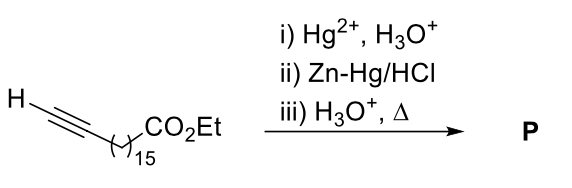
Glycerol reacts completely with excess P in the presence of an acid catalyst to form Q. Reaction of Q with excess NaOH followed by the treatment with CaCl yields Ca-soap R, quantitatively. Starting with one mole of Q, the amount of R produced in gram is ______.
[Given, atomic weight: H = 1, C = 12, N = 14, O = 16, Na = 23, Cl = 35, Ca = 40]
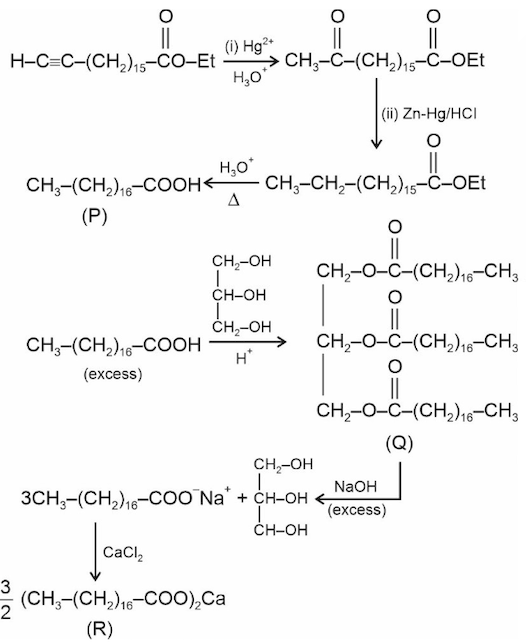
Step 1: oxymercuration-demercuration of the terminal alkyne with Hg/HO gives the methyl ketone .
Step 2: Clemmensen reduction (Zn-Hg/HCl) reduces the new ketone to -CH- giving .
Step 3: acid hydrolysis of the ester yields the C saturated fatty acid: P = (stearic acid, molar mass = g/mol).
Glycerol + 3 P (acid catalyst) gives the triglyceride Q (glyceryl tristearate). One mole of Q contains 3 moles of stearate units.
Q + excess NaOH (saponification) gives 3 moles of sodium stearate + 1 mole of glycerol. Treating sodium stearate with CaCl converts every 2 moles of to 1 mole of calcium stearate .
From 3 moles of sodium stearate (out of 1 mole of Q), we get moles of R.
Molar mass of R: g/mol (stearate anion ).
Mass of R = g.
Concept behind this question
Carboxylic Acid DerivativesNotes, formulas and examples →More previous year questions on Carboxylic Acid Derivatives
Practice more Chemistry Section 3
Concept-wise practice with instant solutions on Fundamenthol.
Start practicing →