
JEE Advanced 2026 Paper 1, Chemistry Section 1 Q4: Carboxylic Acid Derivatives
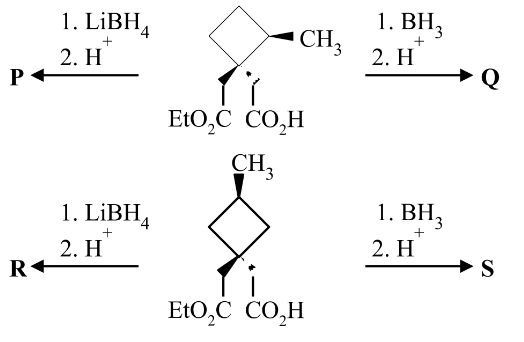
Considering LiBH reduces an ester group to the corresponding alcohol and does not reduce a carboxylic acid group, the correct statement about the major products , , and is
- A
& are identical, and & are diastereomers.
- B
& are diastereomers, and & are identical.
- C
& are diastereomers, and & are diastereomers.
- D
& are identical, and & are identical.
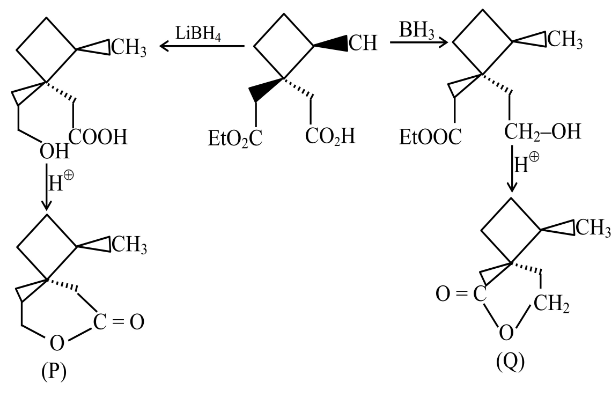
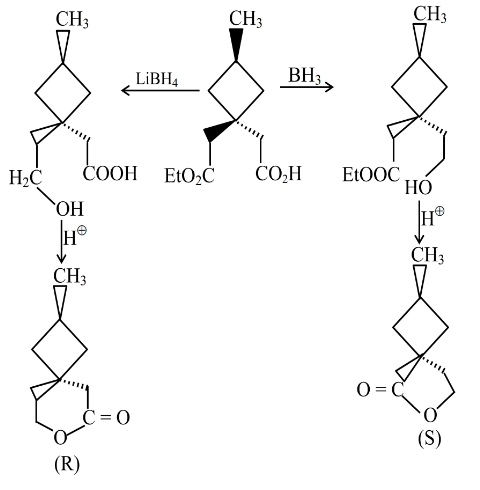
Reagent selectivity. LiBH selectively reduces the ester (–COEt –CHOH) and leaves the carboxylic acid intact. BH behaves oppositely on this substrate: it preferentially reduces the carboxylic acid (–COH –CHOH) and leaves the ester intact.
Lactonisation under acidic workup. In each case the resulting hydroxy-acid (or hydroxy-ester) undergoes intramolecular cyclisation to form a five-membered lactone. The lactone is formed with retention of the existing stereocentres on the ring carbon.
Top substrate. Starting from one diastereomer:
- With LiBH then H: ester reduces to CHOH, then the CHOH cyclises onto the carboxylic acid, giving lactone .
- With BH then H: carboxylic acid reduces to CHOH, then the CHOH cyclises onto the ester, giving lactone .
and both contain the same skeleton but the relative orientation of the CH substituent versus the lactone oxygen/carbonyl differs because the new CHO and C=O attachments are swapped at the ring carbon. They are therefore diastereomers.
Bottom substrate (opposite stereochemistry of the substituted ring carbon). The same argument applies: and are also diastereomers, differing in which of the two CHO / C=O ends is attached at the ring carbon.
Hence & are diastereomers and & are diastereomers. Option (C).
Concept behind this question
Carboxylic Acid DerivativesNotes, formulas and examples →More previous year questions on Carboxylic Acid Derivatives
Practice more Chemistry Section 1
Concept-wise practice with instant solutions on Fundamenthol.
Start practicing →