
JEE Advanced 2024 Paper 2, Chemistry Section 3 Q6: Preparation of Phenol
An organic compound having molecular formula gives ferric chloride test and does not have intramolecular hydrogen bond. The compound reacts with equivalents of to produce oxime . Treatment of with excess methyl iodide in the presence of produces compound as the major product. Reaction of with excess iso-butylmagnesium bromide followed by treatment with gives compound as the major product.
The total number of methyl () group(s) in compound is _____.
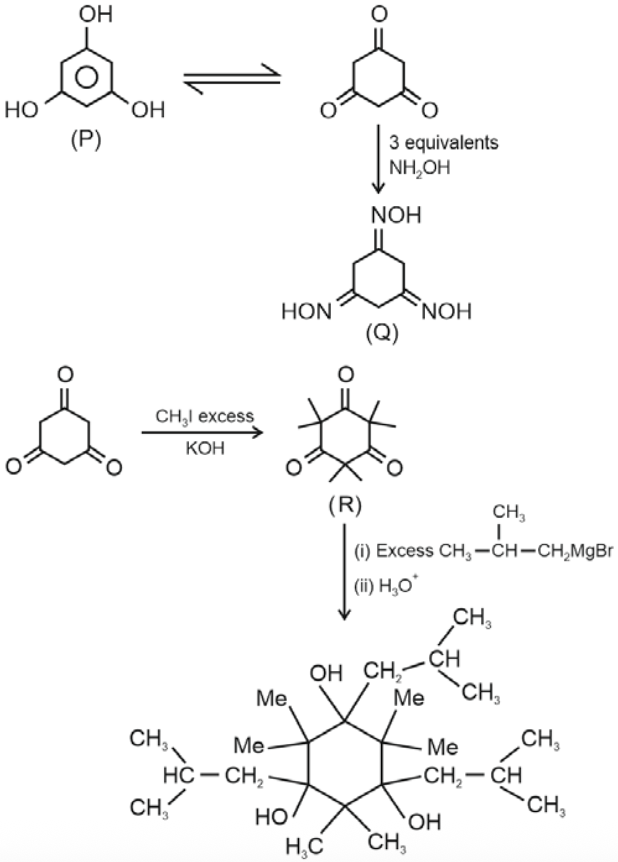
Identifying P. Molecular formula , gives a positive ferric chloride test (so it has a phenolic ), and has no intramolecular hydrogen bond (so the groups are not adjacent in a way that lets them H-bond intramolecularly). The structure that fits is -trihydroxybenzene (phloroglucinol), which has three groups meta to each other.
Phloroglucinol Q. Phloroglucinol exists in tautomeric equilibrium with its tri-keto form, cyclohexane--trione. The triketone reacts with three equivalents of hydroxylamine to give a trioxime .
Phloroglucinol + excess CHI / KOH R. With excess methyl iodide and strong base, both -methylation and -methylation occur at the activated -carbons of the triketo tautomer. The fully methylated product is the -hexamethylcyclohexane--trione (six methyl groups added at the three -positions, two methyls per -carbon).
R + excess iso-butylmagnesium bromide; then HO S. Each of the three carbonyls in adds one equivalent of the Grignard reagent followed by aqueous workup, giving three tertiary alcohols on the ring. Each new carbon centre carries one iso-butyl group (two methyl groups) and an group.
Counting methyls in S.
From the six -methyl groups already on the ring (from step R): methyls.
From three iso-butyl groups added by the Grignard, each contributing two methyls: methyls.
Total: methyl groups.
Concept behind this question
Preparation of PhenolNotes, formulas and examples →More previous year questions on Preparation of Phenol
Practice more Chemistry Section 3
Concept-wise practice with instant solutions on Fundamenthol.
Start practicing →