
JEE Advanced 2024 Paper 2, Chemistry Section 4 Q1: Properties and Important Reactions of Aldehydes & Ketones
PARAGRAPH I
An organic compound with molecular formula decolorizes bromine water and also shows positive iodoform test. on ozonolysis followed by treatment with gives and . While compound shows positive iodoform test, compound does not give positive iodoform test. and on oxidation with pyridinium chlorochromate (PCC) followed by heating give and , respectively. Both and show positive iodoform test.
Complete copolymerization of moles of and moles of gives one mole of a single acyclic copolymer .
[Given, atomic mass: H = 1, C = 12, O = 16]
Q1. Sum of number of oxygen atoms in and is _____.
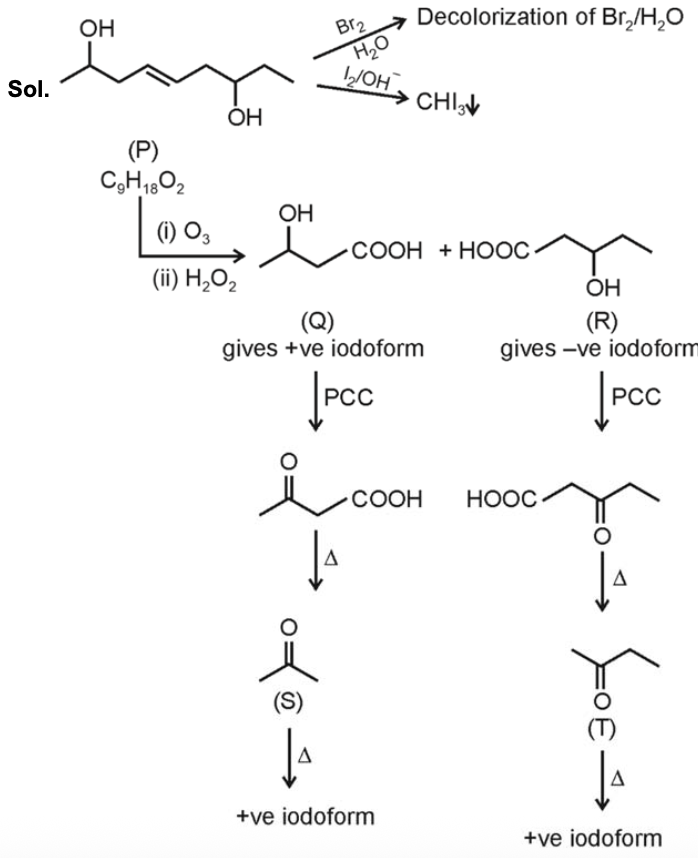
Decoding the structure of . Formula has one degree of unsaturation, so contains one double bond (consistent with decolorising bromine water). The positive iodoform test indicates a or moiety. Oxidative ozonolysis ( then ) cleaves the double bond to give two oxidised fragments: as a hydroxy-carboxylic acid (still iodoform-positive, so it retains a group) and as a hydroxy-carboxylic acid (iodoform-negative, so the on is not on a carbon).
A consistent assignment is:
: (a unsaturated diol — total , one ).
Oxidative ozonolysis cleaves the central :
: (lactic acid analogue, iodoform-positive).
: (a -hydroxy carboxylic acid; the is on a carbon flanked by and propyl, not by , so iodoform-negative).
Q and R S and T (PCC oxidation, then heat). PCC oxidises each secondary to a without touching the . Heating then promotes decarboxylation of the resulting -keto acid.
For : (after decarboxylation, = acetaldehyde, ; iodoform-positive). has oxygen.
For : ( = pentan-2-one, ; iodoform-positive because of the methyl ketone). has oxygen.
Sum of oxygen atoms in and =
Concept behind this question
Properties and Important Reactions of Aldehydes & Ketones Notes, formulas and examples →More previous year questions on Properties and Important Reactions of Aldehydes & Ketones
Practice more Chemistry Section 4
Concept-wise practice with instant solutions on Fundamenthol.
Start practicing →