
JEE Advanced 2025 Paper 1, Chemistry Section 2 Q3: Properties of Alkyl Halides (Halo Alkanes) & Aryl Halides (Halo Arenes)
For the reaction sequence given below, the correct statement(s) is(are)
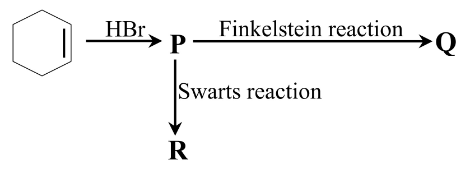
(In the options, X is any atom other than carbon and hydrogen, and it is different in P, Q and R)
- A
C–X bond length in P, Q and R follows the order Q > R > P.
- B
C–X bond enthalpy in P, Q and R follows the order R > P > Q.
- C
Relative reactivity toward S2 reaction in P, Q and R follows the order P > R > Q.
- D
p value of the conjugate acids of the leaving groups in P, Q and R follows the order R > Q > P.
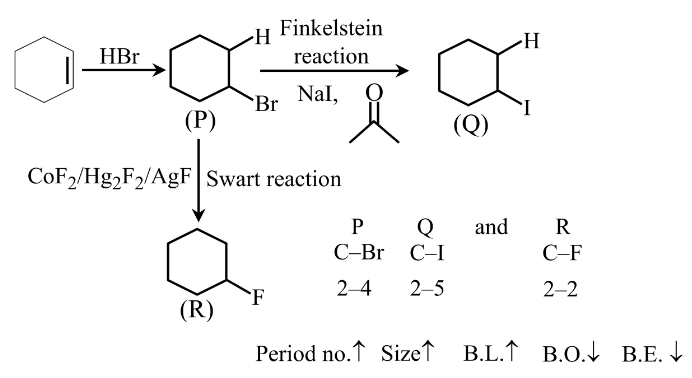
Identifying the products: P = cyclohexyl bromide (C–Br), Q = cyclohexyl iodide (C–I) from the Finkelstein exchange, R = cyclohexyl fluoride (C–F) from the Swarts reaction.
The halogens belong to periods 4, 5 and 2 respectively, so atomic size goes I > Br > F.
(A) Bond length scales with the halogen's size, giving C–I > C–Br > C–F, i.e. Q > P > R. The proposed order Q > R > P is wrong.
(B) Bond enthalpy increases as bond length decreases (and orbital overlap with C improves): C–F > C–Br > C–I, i.e. R > P > Q. Statement is correct.
(C) S2 reactivity depends on leaving group ability; iodide is the best leaving group, fluoride the worst. Order: Q > P > R, so the given order P > R > Q is wrong.
(D) p of HX: HI < HBr < HF (HF is the weakest acid here in aqueous media), so p order is HI < HBr < HF, equivalently Q < P < R. The proposed order R > Q > P is wrong.
Only (B) is correct.
Concept behind this question
Properties of Alkyl Halides (Halo Alkanes) & Aryl Halides (Halo Arenes)Notes, formulas and examples →More previous year questions on Properties of Alkyl Halides (Halo Alkanes) & Aryl Halides (Halo Arenes)
Practice more Chemistry Section 2
Concept-wise practice with instant solutions on Fundamenthol.
Start practicing →