
JEE Advanced 2025 Paper 2, Physics Section 2 Q2: Thin Lens and Mirrors
Two identical concave mirrors each of focal length are facing each other as shown in the schematic diagram. The focal length is much larger than the size of the mirrors. A glass slab of thickness and refractive index is kept equidistant from the mirrors and perpendicular to their common principal axis. A monochromatic point light source is embedded at the center of the slab on the principal axis, as shown in the schematic diagram. For the image to be formed on itself, which of the following distances between the two mirrors is/are correct:
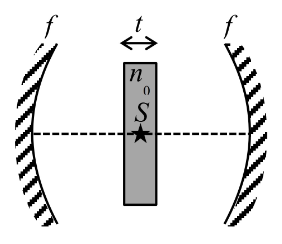
- A
- B
- C
- D
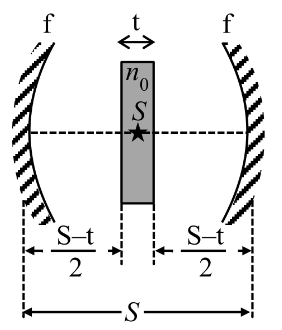
Let denote the mirror separation. The source sits at the midpoint of the slab; from to the edge of the slab is , after which there is air of length up to the mirror. Because the slab is on the path, the slab of thickness in air looks like an apparent path when viewed from outside.
So the apparent object distance of from either mirror, measured through the slab, is
For the image to land back on , the light must retrace its path; this happens either when the object is at the centre of curvature () or at the focus (, giving parallel rays that reflect off the second mirror's focal plane and converge back).
Condition 1: gives
Condition 2: gives
Options (A) and (B) are correct.
Concept behind this question
Thin Lens and MirrorsNotes, formulas and examples →More previous year questions on Thin Lens and Mirrors
Practice more Physics Section 2
Concept-wise practice with instant solutions on Fundamenthol.
Start practicing →