
JEE Advanced 2025 Paper 2, Physics Section 3 Q8: Doppler Effect
An audio transmitter (T) and a receiver (R) are hung vertically from two identical massless strings of length 8 m with their pivots well separated along the axis. They are pulled from the equilibrium position in opposite directions along the axis by a small angular amplitude and released simultaneously. If the natural frequency of the transmitter is 660 Hz and the speed of sound in air is 330 m/s, the maximum variation in the frequency (in Hz) as measured by the receiver (Take the acceleration due to gravity m/s) is ___
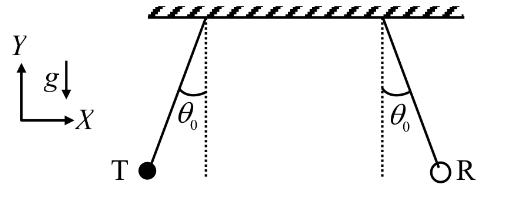
The small-amplitude approximation gives , so and rad.
Both pendulums have angular frequency rad/s, and each bob's maximum speed is
m/s.
The maximum (minimum) observed frequency occurs when source and observer approach (recede) along the line joining them, each with speed :
The maximum variation is
Plugging in m/s, m/s, Hz:
Hz.
Hz.
Concept behind this question
Doppler EffectNotes, formulas and examples →More previous year questions on Doppler Effect
Practice more Physics Section 3
Concept-wise practice with instant solutions on Fundamenthol.
Start practicing →