
JEE Advanced 2026 Paper 1, Physics Section 1 Q1: Rolling Motion
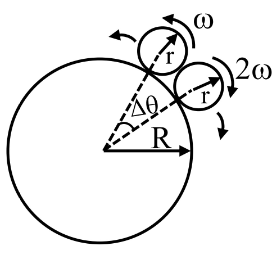
Consider a large disk of radius R and two smaller disks, each of radius , lying on its circumference, as shown in the figure. The smaller disks are initially in contact with each other, with an angular separation between their centers. They are made to roll without slipping in opposite directions, with constant angular velocities and while the large disk is held stationary. The time at which the smaller disks are again in contact is :
[Use and ignore gravity.]
- A
- B
- C
- D
Set up the rolling condition. Each small disk rolls without slipping on the inside of the large disk along the circumference. The contact-point arc lengths covered by the two small disks must, together with the initial gap, total the full circumference traversal needed to meet again.
Geometry of meeting. By symmetry of the angular speeds and , the two contact points move with angular rates on the large disk in inverse proportion. Let the two contact points sweep angles and on the large disk such that (they meet after closing the gap on the far side).
Rolling without slipping gives, for each small disk, , where is the rate at which the small disk's centre revolves around the large disk's centre. Hence the two centres revolve at and .
Initial separation. With , the constraint that the two disks were touching initially gives rad.
Time to meet. The relative angular speed of the two centres about the large disk's centre is . They must close the angular gap (accounting for the finite size of the small disks on both sides).
, which matches option (C).
Concept behind this question
Rolling MotionNotes, formulas and examples →More previous year questions on Rolling Motion
Practice more Physics Section 1
Concept-wise practice with instant solutions on Fundamenthol.
Start practicing →