
JEE Advanced 2026 Paper 1, Physics Section 4 Q1: Superposition of Waves
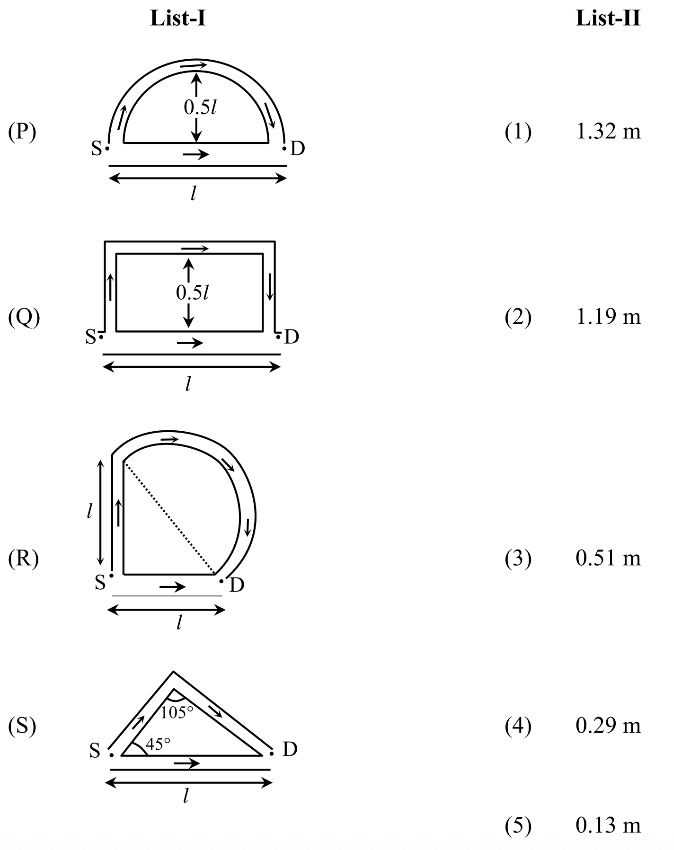
List-I shows four configurations made of straight and semi-circular narrow tubes containing air. A sound wave of wavelength m enters these structures at the point and a sound detector is placed at . Between the points and , the sound travels only through the tubes. List-II contains the possible smallest values of (refer to the figures) for which the detector records maximum amplitude. Ignore effects of sharp corners. [Given ]
Choose the option that best describes the match between the entries in List-I to those in List-II.
- A
P 4; Q 3; R 5; S 1
- B
P 4; Q 3; R 1; S 5
- C
P 3; Q 4; R 1; S 2
- D
P 3; Q 4; R 5; S 2
General principle. Maximum amplitude at requires constructive interference, i.e. path difference with giving the smallest non-zero .
(P) Semicircular detour of diameter over a straight base . Arc length ... more directly, the semicircle of diameter has length ... reworking: path difference where , giving . Setting equal to : m. P 3.
(Q) Rectangular detour: three sides of length versus straight . . Setting : m. Q 4.
(R) Quarter-arc of radius plus a straight segment around the corner; the other path is the straight base . ... more carefully: detour length , straight length along the diagonal, giving . Setting equal to : m. R 5.
(S) Triangle on top of base with angles 45°, 105°, 30°. By the law of sines, the two slanted sides have lengths and , summing to . Path difference . Setting equal to : m. S 2.
Mapping: P 3, Q 4, R 5, S 2, which is option (D).
Concept behind this question
Superposition of WavesNotes, formulas and examples →More previous year questions on Superposition of Waves
Practice more Physics Section 4
Concept-wise practice with instant solutions on Fundamenthol.
Start practicing →