
JEE Advanced 2026 Paper 1, Physics Section 4 Q4: Moment of Inertia
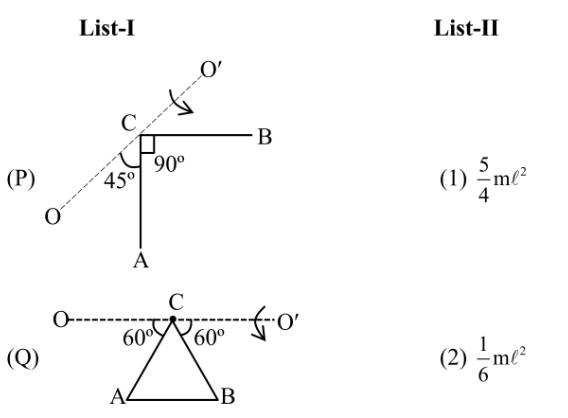
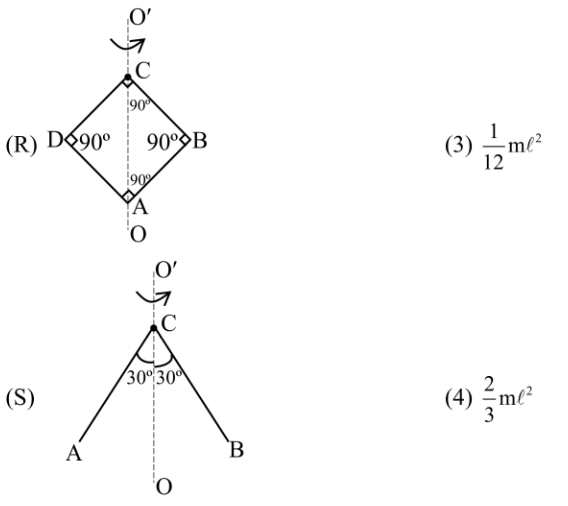
List-I shows four planar structures made of uniform solid rods each of mass and length . In the List-II the possible moment of inertia of these structures about an axis OCO', which lies in the plane of the structures, are given.
Choose the option that describes the correct match between the entries in List-I to those in List-II.
- A
P 5; Q 1; R 4; S 2
- B
P 1; Q 3; R 4; S 2
- C
P 5; Q 3; R 2; S 1
- D
P 5; Q 4; R 2; S 1
General approach. For a uniform rod of mass and length about an axis through one end making angle with the rod, . For rods whose centre is offset from the axis at perpendicular distance , add using the parallel axis theorem (with the centre-of-mass term if the rod is not through the axis).
(P) Two rods CA and CB at 90°, axis OCO' bisecting the right angle. Each rod makes 45° with the axis and passes through C, which lies on the axis. So each contributes . Total . P 5.
(Q) Equilateral triangle, axis through vertex C parallel to base AB. The two upper rods CA, CB pass through C and each make 60° with the axis: contribution . The base AB lies parallel to the axis at perpendicular distance from it, contributing (rod parallel to axis has no term; only the parallel-axis offset matters). Total . Q 1.
(R) Rhombus with 90° vertices, axis along diagonal CA. All four rods pass through either C or A (both on the axis) and each makes 45° with the axis. Each contributes . Total . R 4.
(S) Two rods CA, CB joined at C with axis through C at 30° to each rod. Each rod passes through C and makes 30° with the axis: contribution . Total . S 2.
Mapping P 5, Q 1, R 4, S 2 corresponds to option (A).
Concept behind this question
Moment of InertiaNotes, formulas and examples →More previous year questions on Moment of Inertia
Practice more Physics Section 4
Concept-wise practice with instant solutions on Fundamenthol.
Start practicing →