
JEE Advanced 2026 Paper 1, Chemistry Section 2 Q4: Mechanism of Some Important Reactions of Alkenes
In the following reaction sequence , , and are the major products.
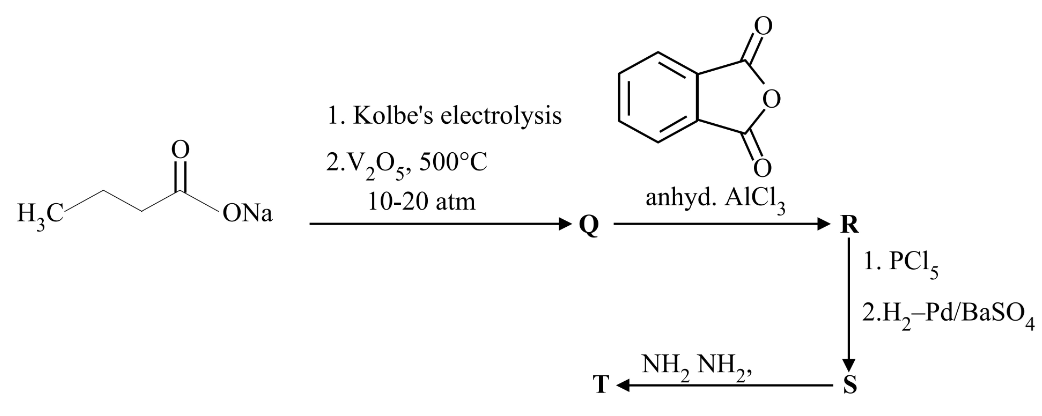
The correct statement(s) about , , and is (are)
- A
on warming with ammoniacal AgNO results in the formation of silver mirror.
- B
on treatment with Cl (excess)/ UV gives gammaxane.
- C
is a heterocyclic compound.
- D
on acid catalyzed intermolecular cyclization followed by treatment with Zn-Hg/HCl gives 9,10-dihydroxyanthracene.
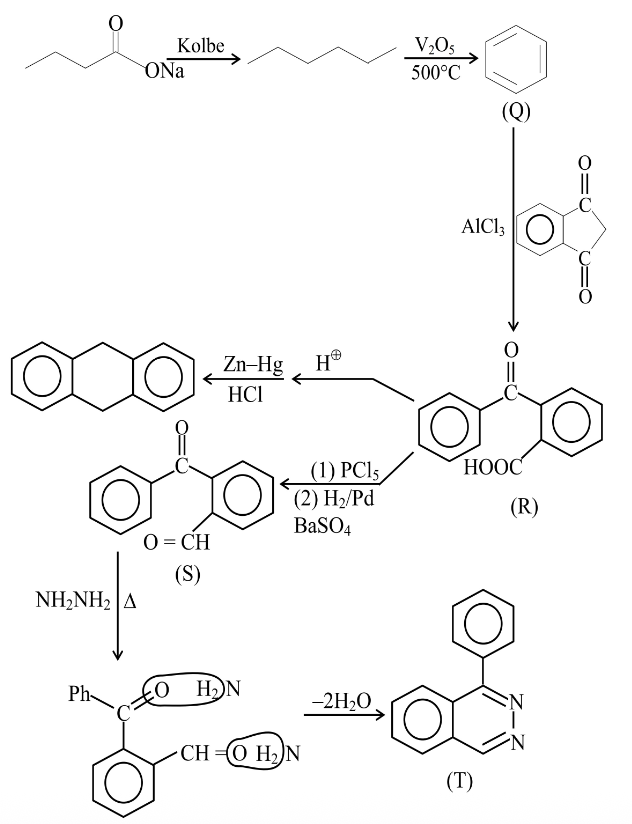
Identify the intermediates.
- Kolbe electrolysis of sodium butyrate produces -hexane (CH(CH)CH). Aromatisation over VO at 500 °C and high pressure gives benzene ().
- Friedel–Crafts acylation of benzene with phthalic anhydride / AlCl produces -benzoylbenzoic acid ().
- with PCl converts –COOH to –COCl; Rosenmund reduction (H/Pd-BaSO) converts the acid chloride to an aldehyde (, -benzoylbenzaldehyde).
- + NHNH: the aldehyde and the ortho-ketone both condense with hydrazine, and after loss of water the product is the heterocycle 1-phenylphthalazine ().
(A) contains an aldehyde (–CHO), which gives a positive Tollens' test with ammoniacal AgNO (silver mirror). Correct.
(B) Benzene + Cl/UV gives 1,2,3,4,5,6-hexachlorocyclohexane (gammaxane / BHC) via radical addition. Correct.
(C) (phthalazine derivative) contains a six-membered ring with two ring nitrogens, hence is heterocyclic. Correct.
(D) Acid-catalysed cyclisation of -benzoylbenzoic acid gives anthraquinone, which on Clemmensen reduction (Zn-Hg/HCl) gives anthracene (not 9,10-dihydroxyanthracene). Incorrect.
Correct answers: (A), (B), (C).
Concept behind this question
Mechanism of Some Important Reactions of AlkenesNotes, formulas and examples →More previous year questions on Mechanism of Some Important Reactions of Alkenes
Practice more Chemistry Section 2
Concept-wise practice with instant solutions on Fundamenthol.
Start practicing →