
JEE Advanced 2026 Paper 1, Chemistry Section 3 Q4: Preparation of Alkynes
Treatment of buta-1,3-diyne with NaNH (2 equivalents), followed by reaction with excess of trans-CH–CH=CH–CH–Br gives as the major product. The maximum number of carbon atoms that are collinear (in a straight line) in is ____.
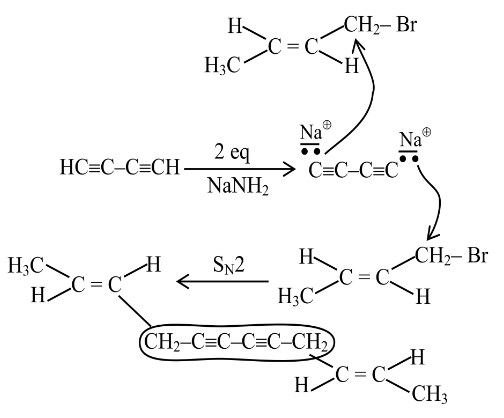
Acid–base step. Buta-1,3-diyne (HCC–CCH) has two terminal acetylenic protons. Two equivalents of NaNH deprotonate both ends to give the bis-acetylide .
Alkylation step. The bis-acetylide performs S2 displacement on the allylic bromide twice (excess), giving a symmetrical product with the chain
CH–CH=CH–CH–CC–CC–CH–CH=CH–CH (with trans geometry on both alkene ends).
Collinearity analysis. The two internal triple bonds together with the four sp carbons and the two sp CH carbons adjacent to them lie on the same straight line (sp–sp–sp–sp axes are collinear, and the CH carbons attached at each end of the diyne system are also on that axis). Counting the carbons that lie on the diyne axis: the 4 sp carbons of the two triple bonds plus the 2 sp CH carbons attached at each end gives 6 collinear carbons. The CH=CH–CH allylic ends are bent away from the axis (sp geometry, bond angle 120°), so they are not collinear.
Answer = .
Concept behind this question
Preparation of AlkynesNotes, formulas and examples →More previous year questions on Preparation of Alkynes
Practice more Chemistry Section 3
Concept-wise practice with instant solutions on Fundamenthol.
Start practicing →