
JEE Main 2025 Apr 2 Shift 1, Chemistry Q2: Preparation of Alkynes
An optically active alkyl halide [A] reacts with hot KOH dissolved in ethanol and forms alkene [B] as major product which reacts with bromine to give dibromide [C]. The compound [C] is converted into a gas [D] upon reacting with alcoholic . During hydration 18 gram of water is added to 1 mole of gas [D] on warming with mercuric sulphate and dilute acid at 333 K to form compound [E]. The IUPAC name of compound [E] is :
- A
But-2-yne
- B
Butan-2-ol
- C
Butan-2-one
- D
Butan-1-al
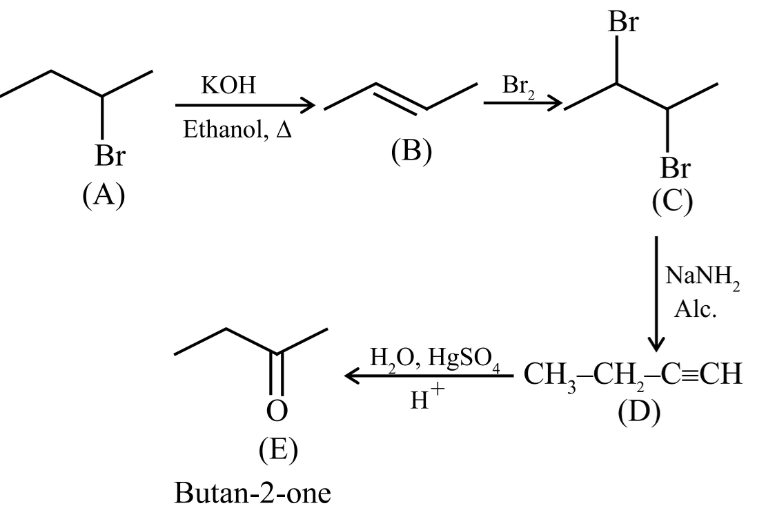
The optically active is sec-butyl bromide (2-bromobutane), the only chiral isomer.
Step 1 (A B): Alcoholic KOH induces E2 elimination. By Saytzeff's rule the major alkene is but-2-ene.
Step 2 (B C): Addition of across the double bond gives 2,3-dibromobutane.
Step 3 (C D): Alcoholic carries out a double dehydrohalogenation, producing the alkyne. Since only 1 mole of water (18 g) adds to 1 mole of D, the alkyne is terminal: but-1-yne, .
Step 4 (D E): Hydration of a terminal alkyne with at 333 K follows Markovnikov addition and gives a methyl ketone via the enol intermediate.
Compound (E) is butan-2-one. Option (3) is correct.
Concept behind this question
Preparation of AlkynesNotes, formulas and examples →More previous year questions on Preparation of Alkynes
Practice more Chemistry
Concept-wise practice with instant solutions on Fundamenthol.
Start practicing →